
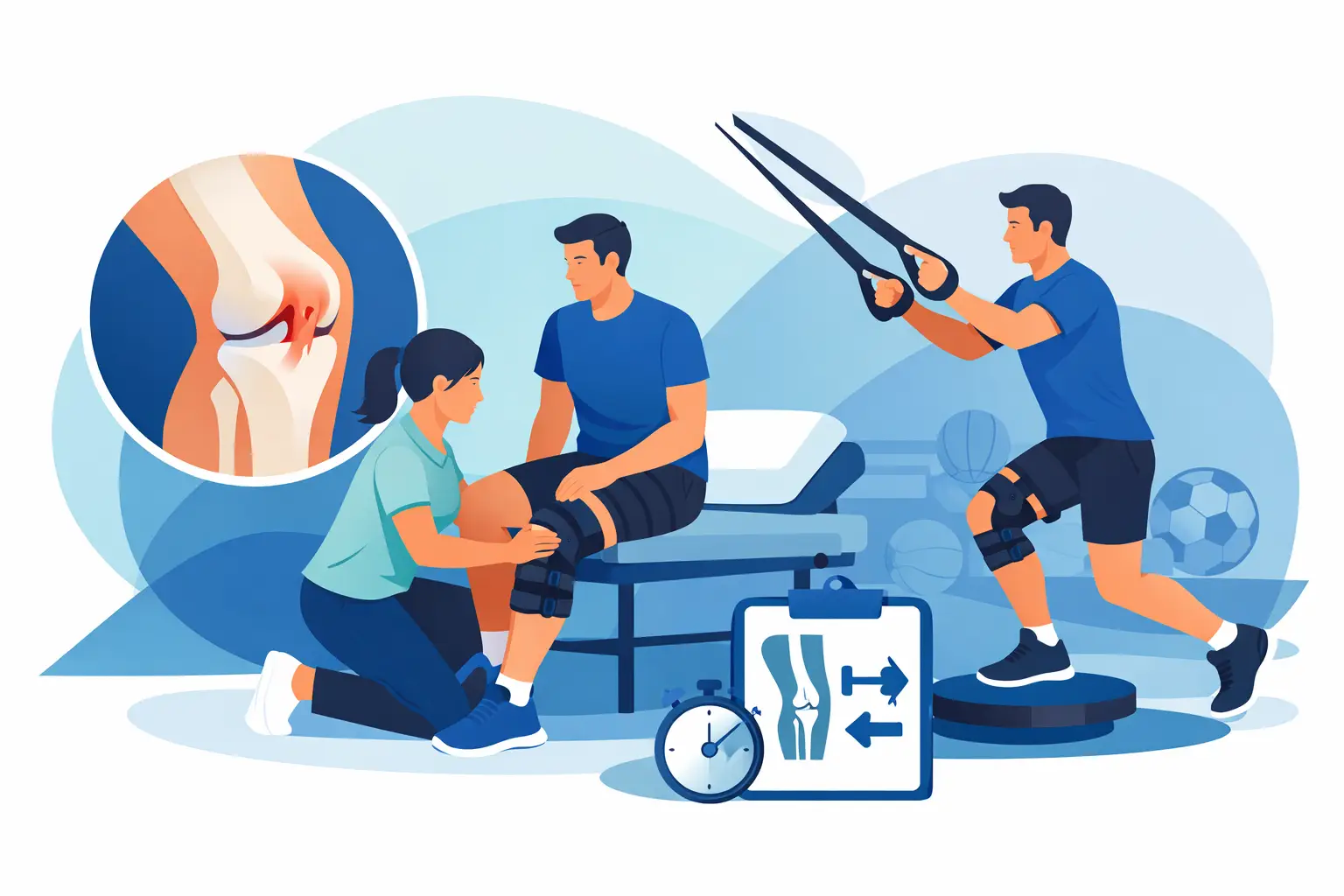
The athlete who feels "pretty good" at 12 weeks is often the one most tempted to rush. Pain has settled, swelling is down, strength is coming back, and normal life feels manageable again. But ACL rehab for athletes is rarely decided by how the knee feels on a decent day. It is decided by how well that knee handles speed, fatigue, force, rotation, and the psychological demand of trusting it when the moment matters.
That is where standard rehab and performance-led rehab start to separate. For an athlete, the goal is not simply to walk without pain or train around the injury. The goal is to return with a knee that can tolerate competition, absorb load efficiently, and hold up over time. That takes precision, patience, and a plan built around sport demands, not generic milestones.
What makes ACL rehab for athletes different
An ACL injury changes more than ligament integrity. It disrupts force production, movement quality, timing, confidence, and often the athlete's relationship with their body. Even after surgery, the graft is only one part of the picture. Quad strength, hip control, trunk positioning, landing mechanics, deceleration strategy, and nervous system readiness all shape the return-to-sport outcome.
For that reason, ACL rehab for athletes needs to go beyond symptom management. Early pain control and range of motion still matter, of course. But a high-level rehab process keeps one eye on the end goal from day one. How will this athlete cut, sprint, absorb contact, or re-accelerate? What does their sport actually demand? Where were their movement limitations before the injury? Those questions change the program.
There is also a practical reality here: timelines vary. A field sport athlete, a skier, a powerlifter, and a runner do not all need the same progression. Nor do two soccer players with the same surgical date. Healing follows biology, but performance restoration follows context.
The phases that matter most
Early phase - calm the knee, restore the basics
In the opening phase, the knee needs to settle. Swelling control, extension range of motion, gait quality, and early quad activation are foundational. If full extension is delayed, everything downstream gets harder. Walking mechanics shift, load distribution changes, and strength work becomes less effective.
This phase can feel deceptively simple, but it sets the tone for the entire rehab. Athletes often want to skip ahead. The better approach is to build clean movement early so later loading has something solid to sit on. Precision matters more than intensity here.
Mid phase - rebuild strength and capacity
This is where real work begins. Strength deficits after ACL injury can linger far longer than many athletes expect, especially in the quadriceps. If the quad does not recover well, the body will find workarounds. Hips overwork, landings stiffen, and asymmetry becomes the default.
A strong mid-stage program progressively restores lower-body force production through controlled loading. That usually includes bilateral and unilateral strength work, tendon-friendly progressions, and a gradual reintroduction of impact. The challenge is dosage. Too little loading leaves the athlete underprepared. Too much, too soon, can irritate the knee and slow momentum.
This is also the stage where movement quality deserves a hard look. Not every athlete needs textbook symmetry in every exercise, but obvious collapse patterns, poor trunk control, and hesitant deceleration should not be dismissed as minor issues. They often become the exact patterns that show up under pressure later.
Late phase - prepare for sport, not just discharge
Many athletes are told they are "done" when they can jog, hop, and complete a handful of gym tests. That may be enough for discharge from basic care. It is not always enough for competition.
The late stage should look increasingly athletic. Sprint mechanics, change of direction, reactive drills, repeated efforts, jump-landing strategy, and sport-specific conditioning need to re-enter the picture. This phase asks a more serious question: can the athlete express strength quickly, repeatedly, and under decision-making demands?
That is where elite recovery becomes more than a phrase. A premium rehab process should bridge the gap between clinic and sport with intent. If the athlete leaves rehab stronger but still tentative in chaos, the job is unfinished.
Strength is non-negotiable, but it is not the whole story
It is hard to overstate the value of strength in ACL recovery. Good rehab tends to produce strong athletes. Poor rehab often produces cautious ones. But strength alone does not guarantee readiness.
An athlete may test well in a controlled environment and still struggle with timing, rhythm, and confidence when movement becomes reactive. They may squat well yet avoid true knee bend on landing. They may pass a hop test while still offloading instinctively during sport.
That is why the best ACL rehab for athletes blends objective testing with movement analysis and honest conversation. Numbers matter. So does how those numbers are produced.
Why return-to-sport timelines are rarely simple
Athletes want a date. Clinicians prefer criteria. Both perspectives make sense.
There are broad timelines commonly discussed after ACL reconstruction, but any fixed promise is risky. Healing tissue, surgical approach, previous injury history, concomitant meniscus or cartilage involvement, training age, and psychological readiness all influence progression. An athlete returning to straight-line running has different demands than one returning to basketball or soccer.
There is also the issue of deconditioning. Even when the knee improves on schedule, the rest of the athlete may not. Aerobic fitness, calf capacity, tendon tolerance, and general power can all fall off during restricted training. Return to sport is not just about whether the knee is ready. It is about whether the whole system is ready.
The psychological side of ACL rehab for athletes
Confidence is often treated like a soft variable. It is not. It changes movement, effort, decision-making, and willingness to load the knee at speed.
Some athletes are physically prepared but still hesitate in cutting or landing. Others look fearless and return before they have rebuilt enough capacity. Both scenarios carry risk. Psychological readiness should be assessed with the same seriousness as strength and function.
That means creating progressions that build trust gradually. It means exposing the athlete to movements that matter to their sport, not just safe clinic versions of them. It also means acknowledging that frustration is part of the process. Athletes who are used to performance and momentum often struggle with the slower rhythm of biological healing. Good coaching helps them stay engaged without chasing shortcuts.
Common mistakes that stall progress
The first is chasing timelines over criteria. A calendar can guide expectations, but it should not overrule what the knee and the athlete are showing.
The second is underloading. Some rehab programs protect the knee for too long, leaving the athlete weak and underprepared. The third is overemphasizing isolated exercises while neglecting real athletic tasks. Knee extensions and squats have value. They are not the full picture.
Another mistake is treating discharge as the finish line. For many athletes, the better model is staged return. First restore tissue tolerance, then athletic qualities, then sport integration, then competitive resilience. That progression tends to produce fewer surprises.
What high-level rehab should feel like
A premium rehab experience is not about making the process feel luxurious. It is about making it precise. The athlete should know what phase they are in, what the current priorities are, how progress is being measured, and what still needs to be earned.
The environment matters too. Athletes do better when rehab feels aligned with performance culture rather than illness. That shift changes buy-in. It reframes rehab from limitation to preparation. At Orchard, that philosophy fits naturally because the lens is not basic recovery. It is human optimization after injury.
The best programs also leave room for adjustment. A knee that reacts poorly after a higher-load week is not always a setback. It may just need better dosage. A plateau in single-leg power may require a different strength emphasis. Good rehab is structured, but never rigid.
When is an athlete truly ready?
Readiness is less about one magical test and more about convergence. The knee is quiet. Strength is close enough to support high demand. Movement quality holds up when speed increases. The athlete can decelerate, cut, land, and re-accelerate without obvious compensation. Conditioning is rebuilding. Confidence is becoming earned rather than forced.
Even then, return should be viewed as a progression, not a switch. Training exposure, minutes, intensity, and recovery all need to be managed intelligently. The first game back is not proof that rehab is over. It is the start of the next phase.
For athletes, ACL recovery can be humbling. It strips training back to fundamentals, exposes weak links, and demands restraint from people who usually excel by pushing harder. But handled well, it can also produce a more resilient athlete - stronger, more aware, and better prepared for the demands of sport than before the injury. That is the standard worth aiming for.