
A treatment table can feel like relief after a hard training block, a stubborn shoulder, or a back that objects to long days at a desk. But relief is not the same as readiness. The active rehab vs passive treatment conversation matters because the right plan should do more than make you feel better for an afternoon. It should restore your capacity to train, work, compete, and move with confidence.
For performance-minded clients, the question is rarely whether hands-on care or recovery technology has value. Both can. The more useful question is what your body needs now, what it needs next, and whether your treatment plan is progressing you toward a meaningful physical goal.
Active Rehab vs Passive Treatment: The Core Difference
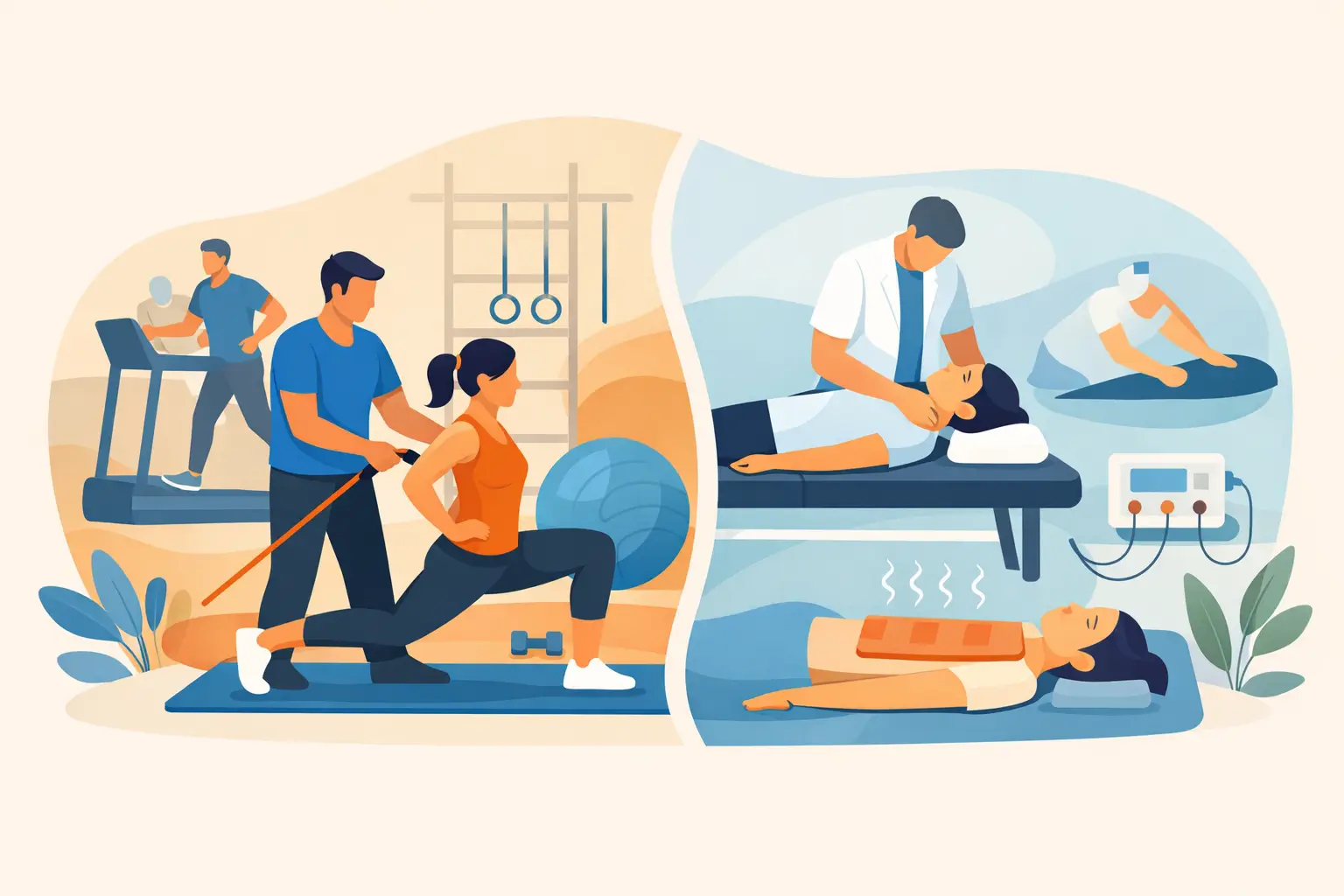
Passive treatment is delivered to you. It may include manual therapy, soft-tissue work, joint mobilizations, acupuncture, taping, heat, ice, or certain recovery modalities. You are receiving care with relatively little physical effort required in the moment.
Active rehabilitation asks you to participate. It uses targeted exercise, movement retraining, progressive loading, balance work, conditioning, and sport-specific preparation to improve how your body performs. The work is prescribed with intent, then adjusted as your symptoms, strength, coordination, and tolerance evolve.
The distinction is not that passive care is ineffective and active rehab is automatically superior. Passive treatment can reduce symptoms, improve short-term movement tolerance, and create an opening for productive training. Active rehab is usually the component that turns that opening into durable capacity.
A skilled clinician does not choose one camp and dismiss the other. They use each tool with a clear rationale, then make sure the plan does not stall at temporary relief.
What Passive Treatment Does Well
Passive care can be highly valuable when pain is limiting your ability to move normally. A flare-up of neck pain, an irritated tendon, a swollen ankle, or acute low-back discomfort may leave you guarded and apprehensive. In those moments, manual therapy or another passive approach may help settle sensitivity enough to make movement feel possible again.
It can also provide useful clinical information. How a joint responds to mobilization, how symptoms change with hands-on treatment, and which positions ease or aggravate discomfort can help guide the next phase of care.
There is also a human element. Being treated by an experienced practitioner can reduce the sense that your body is fragile or broken. That reassurance has value, particularly after an injury has disrupted your usual training rhythm.
The limitation is simple: passive treatment does not ask the body to solve the demands that caused the problem or the demands you want to return to. A massage may make a tight calf feel more comfortable, for example, but it does not automatically improve single-leg control, running volume tolerance, or the ankle strength needed for repeated accelerations.
Passive care is best viewed as a strategic input, not the entire programme.
Why Active Rehab Creates Lasting Change
Your body adapts to the demands placed on it. If you want to return to a heavy deadlift, a long run, a tennis serve, or full days on the ski hill, rehabilitation must gradually expose you to the relevant demands.
That does not mean every session needs to be punishing. Good active rehab is precise. It begins at a level you can tolerate and builds through progressive challenge. Early work may focus on restoring comfortable range of motion, reducing protective movement patterns, and reintroducing basic strength. Later, it may include loaded carries, deceleration drills, rotational control, plyometrics, or sport-specific conditioning.
This process develops more than muscle strength. It improves coordination, confidence, tissue tolerance, and the ability to manage force under fatigue. These qualities are often what separate being pain-free from being genuinely ready.
For an active professional, this distinction is practical. You may no longer feel pain while walking, yet still lack the hip control to return to a fast-paced fitness class. For an athlete, you may be able to jog without symptoms but not tolerate sprinting, cutting, or back-to-back training sessions. Active rehab closes the gap between basic function and performance.
When Passive Treatment Belongs in the Plan
Passive treatment can be particularly useful at the beginning of a rehab process, during a symptom flare, or when it helps you access movement that would otherwise be too uncomfortable. It may also have a place between demanding training sessions, where recovery support helps an athlete arrive at the next session feeling more prepared.
The key is that the intervention has a job. If hands-on care improves your squat depth, the next question is how to use that new range with an appropriate exercise. If taping gives you enough confidence to walk more normally after an ankle injury, the plan should also address ankle strength, balance, and gradual return to impact.
A red flag is a treatment plan that repeatedly resets you without moving you forward. If you feel better for 24 hours but symptoms return as soon as you resume normal activity, the missing ingredient may be a more deliberate loading strategy, not another identical appointment.
When Active Rehab Needs a Slower Start
Active rehabilitation is not a command to push through sharp pain or ignore a significant injury. The right dose depends on the condition, irritability of symptoms, training history, sleep, stress, and the demands you are trying to return to.
After surgery, a fracture, or a substantial acute injury, your clinician may need to respect specific healing timelines and restrictions. With highly irritable pain, the first active steps may be modest: controlled breathing, gentle mobility, isometric contractions, or short, tolerable walks. Progress is still the aim, but the pace must match the body in front of you.
This is where generic exercise sheets fall short. Two people can share the same diagnosis and need very different programmes. A runner with Achilles pain who is preparing for a race has different priorities than someone whose main goal is comfortable daily walking. Both deserve a plan built around their actual life.
A Performance-Led Rehab Framework
High-quality rehabilitation starts with an assessment that looks beyond the painful area. A sore knee may involve training load, hip and ankle mechanics, quad strength, sleep disruption, footwear changes, or a sudden increase in hills. The goal is not to chase a single culprit. It is to understand the pattern and identify the most useful levers for change.
From there, a performance-led plan usually moves through three overlapping stages.
Settle symptoms and restore options
The first priority is to reduce barriers to movement. This may include targeted manual therapy, education, mobility work, and exercises that feel safe enough to perform consistently. The objective is not perfect comfort before action. It is enough comfort and control to begin building.
Build strength and tolerance
Once movement is more available, loading becomes central. Exercises should be challenging enough to create adaptation while staying appropriate for your current capacity. This is where the programme starts to become personal: a cyclist may need sustained single-leg strength, while a hockey player may need lateral force and rapid changes of direction.
Rehearse the return
The final stage prepares you for the environment that matters. That may be a return to lifting, a race build, a demanding travel schedule, or simply being able to keep up with your children without calculating every step. Capacity should be tested in a way that reflects the goal, not just measured by whether the original pain has disappeared.
At Orchard, this approach treats rehabilitation as a return to high-function movement, not a prolonged detour from the life you value.
How to Know Whether Your Plan Is Working
A strong plan has markers beyond pain scores. You should be able to identify changes in range of motion, strength, daily tolerance, training volume, movement quality, or confidence. Some days will be less linear than others, especially when you are rebuilding after a persistent issue. The overall trend, however, should be toward greater capability.
Ask your practitioner what the next benchmark is. It might be completing a controlled split squat, tolerating a 30-minute run, carrying groceries without a flare-up, or returning to a modified practice. Clear benchmarks make rehab feel less abstract and help prevent the common cycle of doing too little for too long, then doing too much too soon.
The best treatment is not necessarily the one that feels most dramatic during the appointment. It is the one that leaves you increasingly capable between appointments, in training, at work, and in the moments that make up your real life.
Choose care that gives you relief when you need it, but also asks your body to become more prepared than it was before. That is where recovery begins to look less like maintenance and more like momentum.