
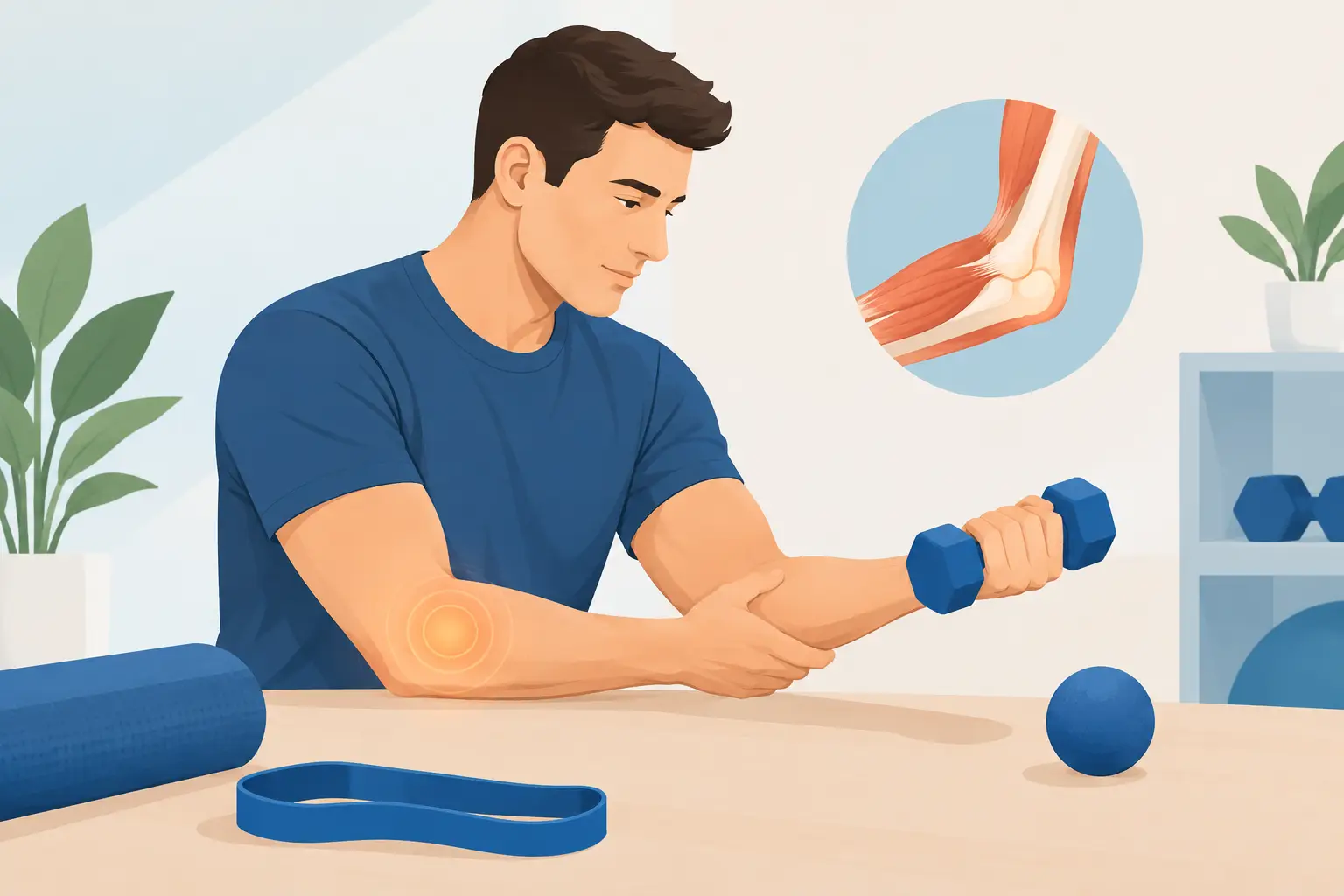
A heavy deadlift, a long day at a keyboard, or one poorly timed backhand can make the outside of the elbow feel unexpectedly limiting. The best exercises for tennis elbow are not about endlessly stretching a sore forearm. They are about restoring the tendon’s capacity to accept force - first in controlled conditions, then in the movements that matter to your training, work, and sport.
Tennis elbow, clinically known as lateral elbow tendinopathy, is often associated with tennis but is not reserved for racquet-sport athletes. It can affect lifters, golfers, climbers, tradespeople, desk-based professionals, and anyone whose wrist extensors are repeatedly asked to grip, stabilize, or decelerate load. The common denominator is not a single activity. It is a mismatch between what the tendon can currently tolerate and what life is demanding from it.
Why exercise is the centre of tennis elbow recovery
The irritated area is usually where the wrist extensor tendons attach to the outside of the elbow. These tissues help lift the wrist, control a racquet or club, and maintain a firm grip. When pain arrives, it is tempting to protect the elbow completely. A short period of relative rest can be useful, especially if pain is sharp or highly reactive. But long-term avoidance tends to reduce capacity further.
Well-chosen loading gives the tendon a reason to adapt. It also restores confidence in gripping, lifting, and training without constantly monitoring the elbow. That is why a high-quality rehabilitation plan progresses from simple, highly controlled effort to heavier, more specific work.
Pain is useful feedback, not an automatic stop sign. During most exercises, mild discomfort is acceptable if it remains manageable, does not build substantially set to set, and settles back to baseline by the following day. As a practical guide, keep symptoms at roughly 3 out of 10 or below while rebuilding. If pain is sharp, escalating, or distinctly worse the next morning, lower the load, range, volume, or frequency.
The best exercises for tennis elbow
The right starting point depends on your irritability, current strength, and the demands you want to return to. The sequence below is a strong foundation for many active adults. Move slowly, use enough resistance to make the final repetitions purposeful, and avoid chasing fatigue for its own sake.
1. Isometric wrist extension hold
This is often the most useful entry point when gripping or lifting is still uncomfortable. Sit with your forearm supported on a bench or table, palm facing down and wrist just beyond the edge. Use the other hand, a light dumbbell, or a resistance band to create resistance as you try to lift the back of your hand upward. Hold without allowing the wrist to move.
Complete four to five holds of 30 to 45 seconds, with one to two minutes of rest. Begin with a light-to-moderate effort, then build toward a challenging but controlled contraction. Isometrics can reduce the sense of threat around painful movement while introducing the tendon to load. They are not a standalone cure, but they are an efficient bridge back to dynamic strength work.
2. Slow wrist extension
Once static holds feel tolerable, progress to slow wrist extension. With the forearm supported and palm down, hold a light dumbbell. Let the wrist lower toward the floor, then lift the back of the hand toward the ceiling. Keep the forearm still and avoid using the shoulder to create momentum.
Perform three sets of 8 to 12 repetitions, taking around three seconds to lower and three seconds to lift. Start with a weight that feels modest. The objective is not to prove strength on day one. It is to create a repeatable loading signal that can be progressed week by week.
Older protocols often emphasize the lowering phase only. Eccentric loading can be effective, but tendons also need to produce force concentrically. A slow, full-range repetition is usually more practical and better reflects the real demands of sport and daily life.
3. Forearm rotation with a hammer or dumbbell
Tennis elbow is rarely just a wrist-extension problem. Rotational control at the forearm matters when you turn a door handle, pour from a pan, swing a club, or stabilize a racquet at contact.
Hold a hammer, light dumbbell, or weighted bar vertically with your elbow bent to 90 degrees and tucked by your side. Slowly rotate the palm up, then down, controlling the weight rather than allowing it to pull you into end range. Complete two to three sets of 8 to 10 repetitions in each direction.
The longer the lever, the more demanding the exercise becomes. Holding the end of a hammer may be too aggressive initially; gripping closer to the head is a sensible way to scale it. Precision matters more than range at the beginning.
4. Progressive grip training
Grip strength is often reduced with lateral elbow pain, and avoiding every gripping task can leave the entire arm underprepared. Start with a soft ball, therapy putty, or hand gripper that allows a clean, comfortable squeeze. Hold each squeeze for three to five seconds, completing two to three sets of 10 to 15 repetitions.
Keep the wrist neutral rather than bent back. If squeezing directly aggravates the elbow, begin with lower effort or shorter holds. Progress by increasing resistance, duration, or the demands of the task, such as carries with a kettlebell or dumbbell. Heavy carries are particularly valuable later in rehabilitation because they blend grip endurance with shoulder and trunk control.
5. Shoulder and upper-back strength
The elbow does not operate in isolation. If the shoulder blade and rotator cuff cannot position the arm well under load, the forearm may compensate. For athletes returning to racquet sports, golf, or strength training, this becomes especially relevant as intensity rises.
Include two or three sets of 10 to 15 controlled repetitions of a cable or band row, external rotation, and a chest-supported reverse fly. These movements should feel smooth and deliberate, not like a rushed circuit. They will not replace direct wrist work, but they create a stronger platform for it.
How to progress without provoking a flare-up
A tendon responds best to a clear, consistent plan. Choose two or three direct elbow sessions per week, leaving at least a day between heavier loading sessions. On other days, low-level isometrics or light mobility may be appropriate if they feel settling rather than irritating.
Progress one variable at a time. Add a small amount of weight before adding many more repetitions. Once slow wrist extensions and grip work are well tolerated, introduce more sport-specific or gym-specific loading: controlled pull-ups, rowing variations, heavier carries, racquet drills, or gradual barbell work. The exact choice depends on the activity you want back.
A useful test is whether your elbow handles both the session and the next morning well. Pain that appears briefly but returns to baseline is often acceptable. Pain that lingers, disrupts sleep, weakens grip noticeably, or continues to rise for 24 to 48 hours suggests the current dose is too high.
Common mistakes that slow progress
The first is treating stretching as the entire solution. Gentle forearm stretches can feel relieving, but aggressive stretching can irritate a sensitive tendon and does little to rebuild its load tolerance on its own. Use mobility as an accessory, not the main event.
The second is returning to high-demand work too abruptly. A pain-free day does not necessarily mean the elbow is ready for repeated serves, maximal pull-ups, or a full volume of heavy curls. Capacity is built over weeks, not proven in one session.
The third is loading only the sore spot while ignoring technique and training context. A sudden increase in racquet time, a grip that is too large or too small, poor deadlift setup, or an aggressive jump in training volume can keep the area reactive. Rehabilitation works best when the programme and the cause of overload are addressed together.
When expert assessment is worth it
Not every pain on the outside of the elbow is tennis elbow. Nerve irritation, neck-related symptoms, joint issues, or a more significant injury can produce similar discomfort. Seek a physiotherapy assessment if you have numbness or tingling, major swelling, pain after a fall, marked loss of strength, night pain, or symptoms that are not improving after several weeks of sensible load management.
For active clients, the value of an assessment is not simply receiving a list of exercises. It is identifying the precise load your elbow can tolerate now, then building a progression that respects your sport, training standards, and performance goals. At Orchard, that means looking beyond symptom relief to the movement and capacity required for a confident return.
The goal is not to keep protecting your elbow forever. It is to build an arm that can grip, rotate, lift, and perform without hesitation - with enough reserve capacity for the demands you choose next.