
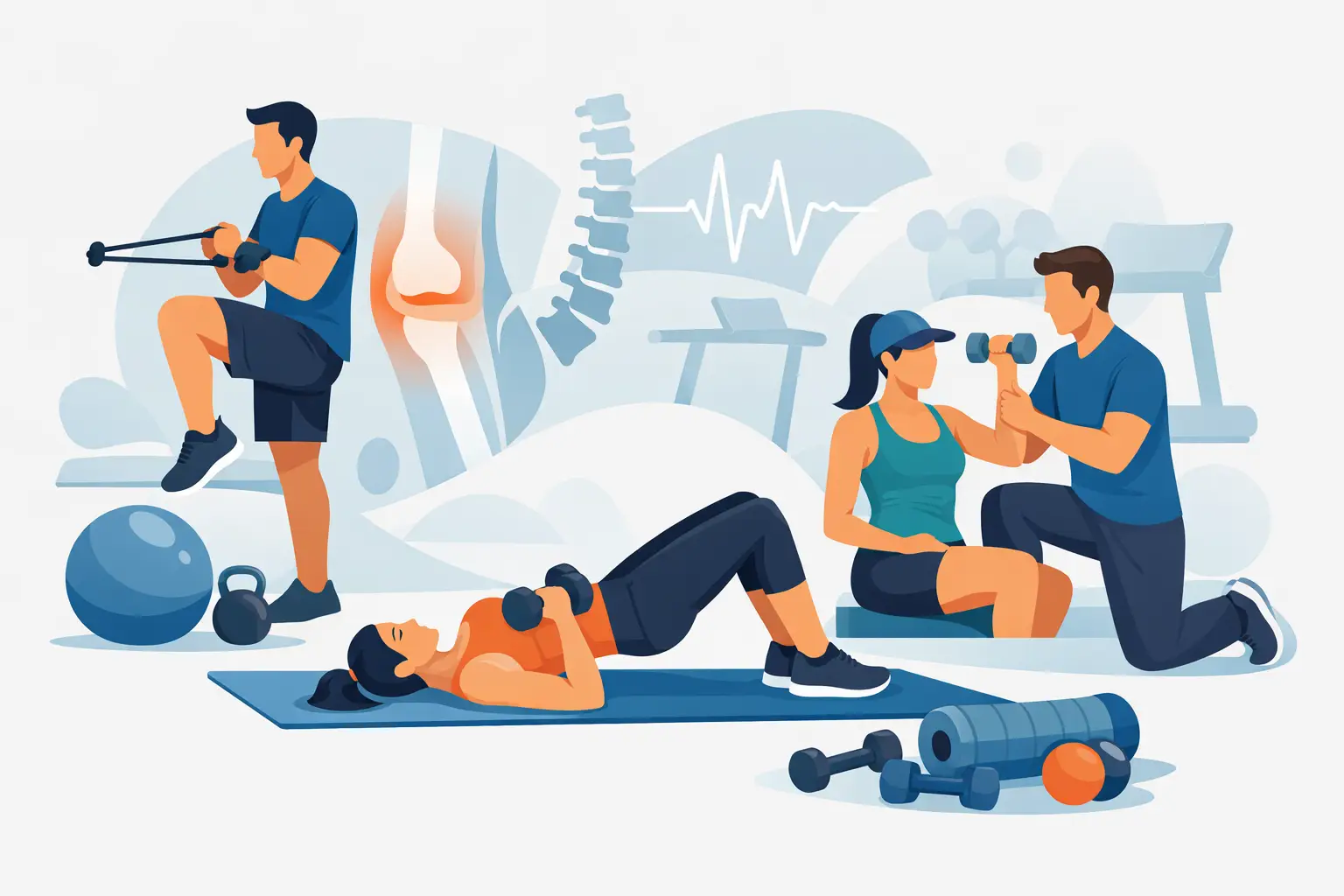
A return to sport is not won when pain first settles. It is earned when your body can absorb force, control position, and repeat the demands of training without hesitation. The best rehab exercises for athletes do more than strengthen an injured area. They reconnect the whole system - mobility, stability, power, conditioning, and trust in movement.
For a runner recovering from Achilles pain, a hockey player rebuilding after a groin strain, or a lifter working through shoulder irritation, the right exercise selection is never a generic checklist. It is a progression. The target is not simply to feel better at rest. It is to perform under speed, load, fatigue, and the unpredictable moments that define sport.
What Makes a Rehab Exercise Worth Doing?
A useful rehabilitation exercise has a clear job. Early on, that job may be reducing sensitivity and restoring comfortable range of motion. Later, it may be rebuilding maximal strength or exposing the body to the deceleration, rotation, and single-leg control required in competition.
The strongest programs move from local capacity to sport-specific performance. Local capacity means the tissues closest to the injury can tolerate load. Performance means the athlete can integrate that capacity into the movements their sport actually asks of them.
That distinction matters. A knee that tolerates a slow bodyweight squat is not necessarily ready for a hard landing from a rebound. A shoulder that handles a band exercise is not automatically prepared for an overhead serve. Rehab must close that gap deliberately.
The Best Rehab Exercises for Athletes Follow a Progression
The exercises below are not a substitute for an individual assessment. Injury history, pain behaviour, training age, surgery status, and sport demands all change the prescription. Still, these movement patterns appear repeatedly in high-quality athletic rehab because they build qualities that transfer.
Isometric holds for an intelligent starting point
Isometrics create muscular tension without visible joint movement. Think of a split squat hold, a wall sit, a calf raise hold, or an external rotation hold for the shoulder. They can be especially useful when a tendon or joint is irritable and heavy movement is not yet well tolerated.
Their value is not that they are painless for everyone. It is that they offer a controlled way to introduce load, establish confidence, and assess response. A runner with a sensitive Achilles may begin with a supported calf raise hold; an athlete with patellar tendon pain may use a Spanish squat hold. Load, duration, and symptoms should guide the dose.
Isometrics are a starting point, not a destination. Once the tissue tolerates them well, the athlete needs movement through range and eventually faster, more demanding loading.
Slow strength work to rebuild tissue capacity
Controlled resistance training is the foundation of most return-to-sport plans. Slow, deliberate repetitions make it possible to build force production while monitoring form and symptoms. Common choices include split squats, step-downs, Romanian deadlifts, rows, presses, and loaded carries.
Single-leg work deserves particular attention. Sport rarely happens in perfectly symmetrical positions. A rear-foot elevated split squat, single-leg RDL, or controlled step-down can reveal side-to-side differences in strength and pelvic control that a bilateral squat may hide.
The trade-off is that single-leg exercises are not automatically superior. A heavy bilateral squat or deadlift may be the more efficient option when the priority is building overall strength. The best program uses both, selected for the athlete rather than for the trend.
Eccentric training for deceleration and tendon resilience
Eccentric contractions occur when a muscle produces force while lengthening. Lowering into a squat, landing from a jump, and controlling the descent of a calf raise are all eccentric tasks. They matter because many sports injuries occur when the body cannot manage force quickly enough during deceleration.
Tempo split squats, slow heel drops, hamstring sliders, Nordic hamstring variations, and controlled landing drills can improve this quality. Eccentric work is demanding, often producing delayed muscle soreness, so it needs to sit intelligently within the broader training week.
For tendon rehabilitation, eccentrics can be highly effective, but they are not the only answer. Heavy slow resistance, isometrics, and plyometric loading each have a place depending on the stage of recovery and the athlete's sport. A basketball player needs more than slow calf raises before returning to repeated jumping. They need to progress toward the speed of the game.
Anti-rotation and trunk control for force transfer
The trunk does not need to remain rigid in every athletic movement. It does need to manage force efficiently. Exercises such as Pallof presses, offset carries, dead bugs, side planks, and cable lifts teach the athlete to control rotation, extension, and lateral movement under load.
This is particularly relevant for athletes returning from hip, groin, low-back, or shoulder issues. A stronger trunk will not erase every injury risk, but it can improve how force moves between the lower and upper body. The goal is not an endless core circuit. It is enough capacity to maintain quality when the demands increase.
Landing, hopping, and change-of-direction drills
A return to field, court, or trail sport requires more than gym strength. Athletes need to regain their ability to accept force, then create it quickly. Landing mechanics, low-level hops, bounds, and change-of-direction drills bridge that gap.
Start with quiet, controlled landings. Can the athlete land with a stable knee, hip, and foot position? Can they hold that landing briefly without pain or excessive shifting? From there, progress to repeated jumps, single-leg hops, lateral movement, acceleration, and planned deceleration.
The order matters. A single maximal jump may look impressive, but repeatability is often the more relevant measure. If mechanics collapse after several contacts, the athlete may not yet have the capacity for a full practice or match.
Sport-specific conditioning to restore confidence
The final phase is often where generic rehab falls short. A healed structure must still be prepared for the energy demands and chaos of sport. That may mean interval running for a soccer player, repeated skating efforts for a hockey player, controlled serving volume for a tennis player, or progressive overhead work for a volleyball athlete.
Conditioning should build alongside strength, not after it. An athlete who is strong but under-conditioned may compensate under fatigue, increasing the chance of symptoms returning. Exposure is the treatment here: measured, progressive, and specific enough to reflect the return target.
How to Dose Rehab Without Guesswork
More is not always better. The appropriate dose depends on the exercise, injury, and training schedule. As a practical rule, mild discomfort that settles quickly and does not worsen over the next 24 hours can often be acceptable in a clinician-guided plan. Sharp pain, increasing swelling, a limp, loss of range, or symptoms that escalate after each session are signals to reassess.
Track more than pain. Note load used, repetitions, perceived effort, movement quality, sleep, and how the area responds the following day. These details turn rehab from a hopeful routine into a precise decision-making process.
It is also wise to protect the athlete's overall training identity. If an injured runner cannot yet tolerate high-volume running, they may maintain fitness with cycling, pool work, or carefully selected strength training. If a shoulder limits pressing, lower-body development and conditioning can still move forward. Rehab works best when it preserves momentum rather than placing the athlete in complete shutdown.
When Exercise Needs a More Individual Plan
Some situations require closer clinical oversight: a suspected fracture, significant instability, post-operative rehabilitation, neurological symptoms, persistent swelling, locking, or pain that repeatedly returns despite sensible load changes. The same is true when an athlete is trying to return for a fixed competition date. A deadline can be useful, but it should not force a body through stages it has not earned.
At Orchard, rehabilitation is approached as performance preparation, not a passive wait for symptoms to disappear. The most effective plan combines hands-on clinical reasoning with progressive strength, movement retraining, and return-to-sport exposure that matches the life and sport you intend to return to.
The right exercise is the one that meets your body where it is, then asks for slightly more at the right moment. Build that progression with patience and precision, and your return can be more than a recovery - it can be a stronger standard for how you move next.