
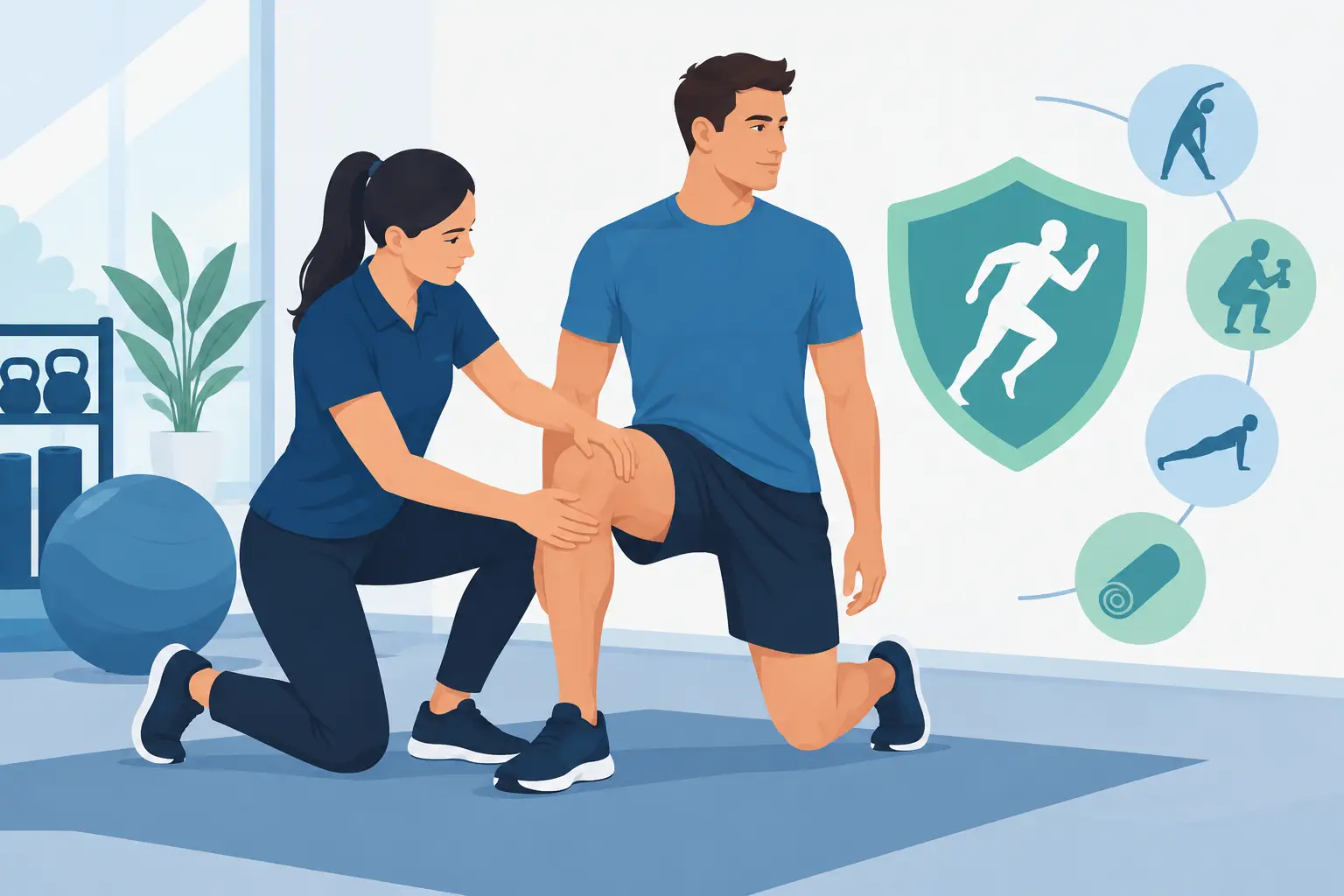
A calf that tightens during the final kilometres of a run. A shoulder that starts to pinch after a heavier block of training. A knee that feels fine in the gym, then protests after a weekend on the court. These are rarely random events. The question, can sports therapy prevent injuries, is really a question about whether we can identify strain before it becomes a forced stop.
For active people, prevention is not about wrapping the body in caution. It is about building enough capacity, control and recovery into your routine that training remains productive. Sports therapy can play a meaningful role in that process, particularly when it is used as performance care rather than a last resort after pain arrives.
Can sports therapy prevent injuries before they happen?
Not completely. No therapist, screening protocol or mobility routine can guarantee an injury-free season. Sport carries uncertainty: an awkward landing, a collision, an unexpected change in surface or a moment of fatigue can overwhelm even a well-prepared body.
What sports therapy can do is reduce avoidable risk. It can reveal patterns that make a particular athlete or active adult less prepared for the demands they are placing on themselves. It can also help manage the gap between what the body can currently tolerate and what training, work or sport requires.
That distinction matters. Injury prevention is not a single appointment or a generic list of corrective exercises. It is an ongoing process of matching capacity to demand. When demand rises faster than capacity, tissues tend to become irritable. When capacity is developed progressively, the body is better positioned to absorb load.
For someone preparing for a marathon, that may mean improving calf and hip strength while building weekly mileage with more intention. For a tennis player, it may mean restoring shoulder rotation, then adding rotational strength and serving tolerance. For a high-performing professional who trains around a demanding schedule, it may mean recognising that poor sleep, long travel days and compressed workouts change the recovery equation.
The performance assessment is where prevention begins
A premium sports therapy approach begins with context, not assumptions. Pain history is relevant, but so are training volume, movement habits, prior injuries, footwear, competition schedule, recovery quality and the goals that make the work worthwhile.
A considered assessment may look at joint range of motion, strength, balance, coordination, control under fatigue and how you move through the tasks that matter to you. A runner may be assessed through single-leg loading and running mechanics. A lifter may need an analysis of squat or hinge strategy. A field athlete may benefit from testing acceleration, deceleration and change of direction.
The point is not to hunt for a perfectly symmetrical body. Human bodies are not perfectly symmetrical, and small differences do not automatically predict injury. The value lies in finding meaningful limitations: a recurring side-to-side strength deficit after an old ankle sprain, poor trunk control when landing, a shoulder that cannot access the positions needed for overhead work, or a workload that has escalated too quickly.
This is where sports therapy becomes more precise than a standard stretching plan. The intervention should reflect the sport, the person and the specific exposure they need to handle.
Movement quality needs a job to do
Better movement is useful when it improves your ability to produce force, absorb force or repeat a skill with less unnecessary strain. It is not useful merely because it looks aesthetically perfect.
A therapist may use hands-on treatment to ease symptoms or restore short-term movement options. That can be valuable, especially when stiffness or pain is disrupting training. But manual therapy alone is rarely the prevention strategy. Its strongest role is often to create a window in which targeted exercise, skill work and progressive loading can take hold.
Strength is one of the clearest protective factors
Tissues adapt to appropriate load. Tendons, muscles and bones all require challenge to become more resilient. This is why a prevention plan should not leave you perpetually cautious or dependent on treatment. It should make you more capable.
The right programme may include heavy slow strength work for a sensitive tendon, single-leg exercises for running and cutting sports, controlled plyometrics for landing tolerance, or rotational training for golf and racquet sports. The exercise selection matters, but progression matters more. A perfect exercise performed at the wrong dose can still irritate an already overloaded system.
This is also why copying an elite athlete’s programme is rarely the answer. Their training history, recovery resources and physical baseline may be entirely different from yours. Effective sports therapy meets your starting point, then builds toward the standard your lifestyle or sport demands.
Load management is not the same as doing less
Many injuries emerge during abrupt changes: the first ski weekend after months away, a return to league play after a busy quarter at work, or a sudden increase in long runs because race day is approaching. The body does not read your calendar. It responds to the load it receives.
Sports therapy can help you make intelligent adjustments without abandoning momentum. That may mean reducing one variable while maintaining another - keeping strength training in place while temporarily lowering running volume, for example. It may mean planning higher-intensity sessions farther apart, or building a return-to-sport progression after a previous injury.
The goal is not to eliminate stress. It is to apply stress at a level that produces adaptation rather than repeated breakdown.
Recovery deserves equal attention. Sleep, nutrition, hydration and rest days are not background details for serious training. They influence how well you tolerate the work. Recovery services can help you feel better and move more freely, but they cannot compensate for a programme that repeatedly exceeds your available capacity. The best results come when treatment, training and recovery are aligned.
When preventative sports therapy is most valuable
Preventative care is especially useful at transition points. A new training cycle, a return after injury, the start of a competitive season, a major race build or a shift into a more demanding fitness routine all create new demands on the body.
It can also be valuable when nothing feels dramatically wrong, but something no longer feels reliable. Perhaps you are constantly managing tightness, losing confidence in one side, or needing longer to recover after sessions that once felt routine. These signals are worth assessing before they become pain that dictates your choices.
At Orchard, the aim is not simply to get clients out of discomfort. It is to understand the performance standard they want to return to, then build a practical route toward it. That may include treatment, strength and mobility work, movement retraining, and a clear plan for progressing back to the activities that matter.
What sports therapy cannot replace
Sports therapy is most effective when it is part of a broader performance system. It cannot make poor technique irrelevant, erase the consequences of chronic under-recovery or protect you from every unpredictable event in sport.
It also cannot replace medical assessment when symptoms are severe, sudden or escalating. Significant swelling, a visible deformity, loss of strength, numbness, inability to bear weight or pain that persists at rest deserves timely clinical attention.
For less urgent concerns, the better question is often not, “Should I stop?” It is, “What can I continue, what needs to change, and how do I build back?” A skilled therapist helps answer that without defaulting to either extreme: pushing through everything or shutting training down unnecessarily.
The most effective prevention plan is quietly ambitious. It respects the signals your body provides, prepares you for the demands you choose, and keeps the focus where it belongs: not merely avoiding injury, but staying ready for the work, sport and life you want to pursue.