
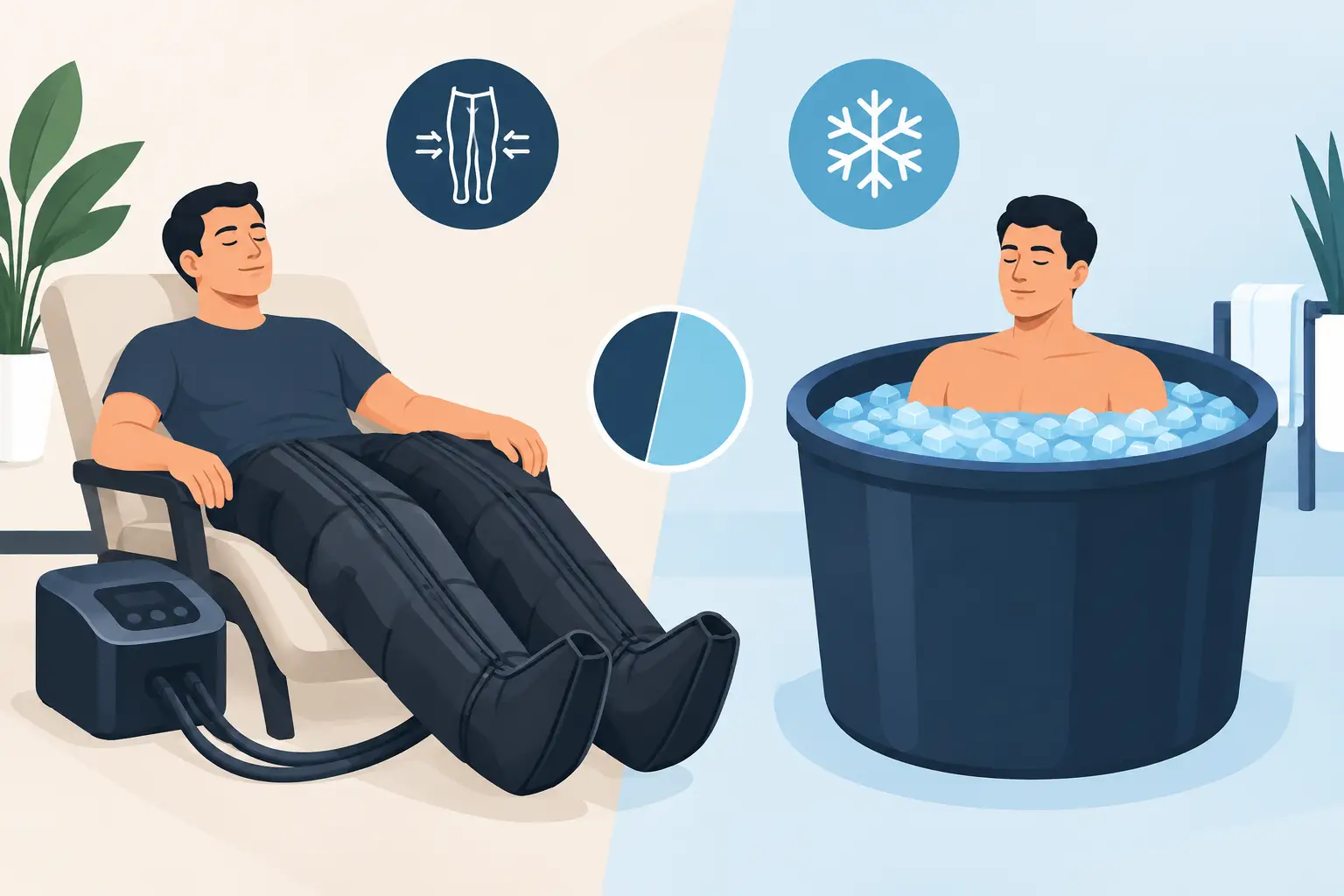
A hard training block can leave your legs feeling heavy before it leaves them truly damaged. That distinction matters when choosing compression boots versus ice baths. One is designed to create a controlled, comfortable recovery ritual with intermittent pressure; the other delivers a potent cold stimulus that can change how you feel quickly. Neither is a universal answer. The right choice depends on what your body needs next.
For active adults, the goal is rarely to recover in the abstract. It is to arrive at tomorrow's run, court session, lift, commute, or workday with enough capacity to move well. That calls for a more precise approach than assuming the most uncomfortable recovery method is the most effective.
Compression Boots Versus Ice Baths: The Core Difference
Compression boots use pneumatic chambers to apply sequential pressure to the feet, calves, and often the thighs. The sensation is rhythmic and contained: the boots inflate, hold briefly, and release. Most people use them after training, travel, or long periods on their feet because they can reduce the subjective feeling of heaviness and provide a low-effort transition out of exertion.
Ice baths, also called cold-water immersion, expose the body to cold water for a short period. The immediate effect is more dramatic. Cold can reduce skin and muscle temperature, alter pain perception, and create a strong nervous-system response. For some athletes, that makes an ice bath feel exceptionally effective after demanding competition or a punishing run.
The distinction is not simply gentle versus intense. Compression is primarily a comfort, circulation, and recovery-perception tool. Cold exposure is a stressor that may be useful when soreness and short-term readiness take priority. Both can have a place in a high-performance recovery plan, but their timing should be intentional.
When Compression Boots Make More Sense
Compression boots are often the better fit when you want recovery support without adding another significant stressor. They are particularly useful after endurance sessions, lower-body strength work, long flights, tournaments, or days with a lot of standing. A 20 to 45-minute session can create a noticeable sense of lighter legs, even if it does not replace sleep, nutrition, or well-managed training volume.
The evidence is strongest around perceived recovery rather than dramatic physiological transformation. In practical terms, that still has value. If your legs feel more comfortable, you may be more likely to walk, perform mobility work, eat well, and return to normal movement rather than collapsing on the sofa for the evening.
They also suit people who need to train frequently. If you have a hard interval session in the morning and a technical practice the next day, compression can be an easy addition to the recovery window. It is quiet, predictable, and does not require the mental effort of lowering yourself into cold water.
What Compression Boots Do Not Do
Premium equipment can make ordinary recovery feel more deliberate, but it does not erase fatigue or repair tissue overnight. Compression boots do not flush lactic acid from your legs. Lactate is normally cleared relatively quickly after exercise, and it is not the cause of next-day soreness.
They also cannot compensate for a poorly designed program. Persistent heaviness, declining performance, disrupted sleep, or pain that changes your movement pattern deserves a closer look at load, technique, and recovery capacity. A recovery modality should support the plan, not conceal a problem within it.
When an Ice Bath May Be Worth It
Ice baths can make sense after a high-impact event when rapid symptom relief and next-day function matter more than maximizing a long-term training adaptation. Think multi-day tournaments, back-to-back matches, endurance races, or an unusually demanding competition schedule. In those moments, reduced soreness and a temporary lift in perceived readiness can be valuable.
Cold water can also be appealing after training in heat. The cooling effect may improve comfort and help an athlete feel settled after a session that has pushed body temperature high. That is a context-specific use, not a requirement after every workout.
The trade-off is that cold exposure is not neutral. Regular cold-water immersion immediately after resistance training may blunt some of the signalling processes associated with strength and muscle-building adaptation. If hypertrophy, strength development, or tissue capacity is your primary objective, routinely ending every lift with an ice bath is not the most strategic move.
A better approach is to reserve cold immersion for competition periods, unusually high soreness, or situations where you need to perform again soon. On normal strength-training days, a protein-rich meal, hydration, gentle movement, and quality sleep will usually serve your adaptation better.
How Cold Is Cold Enough?
More extreme is not automatically more effective. Very cold water can create an intense stress response, and longer sessions can leave you shivering, depleted, or uncomfortable for hours. A brief, tolerable exposure is generally more useful than treating the bath as a test of toughness.
Your response matters. If cold water consistently leaves you tense, anxious, or unable to warm up afterward, it may not be the right tool for you. Recovery should leave you better positioned for the demands ahead, not simply proud that you endured it.
Choose Based on the Next 24 Hours
The best decision often comes from one question: what are you preparing your body to do next?
If tomorrow calls for another competition, a long race stage, or a physically demanding workday, an ice bath may help manage discomfort and preserve short-term readiness. If you are in a developmental training phase and want to build strength, power, or muscle over months, compression boots are typically the less disruptive option after lifting.
If the issue is general lower-leg fatigue after travel or a long day at a desk, compression is usually the more appropriate choice. If the issue is sharp pain, swelling after an acute injury, numbness, instability, or a sudden loss of function, neither modality should be your first move. That is a clinical assessment conversation.
This is where recovery becomes more than a menu of premium services. The same athlete may use compression after a lower-body session on Tuesday, skip both modalities after an easy run on Thursday, and use cold exposure after a weekend event. Context creates value.
Safety and Smart Boundaries
Compression boots are not appropriate for everyone. People with known or suspected blood clots, significant vascular disease, uncontrolled heart conditions, active infection, or certain forms of swelling should seek medical guidance before using them. If compression causes pain, tingling, unusual numbness, or colour changes in the limb, stop the session.
Ice baths also require caution. Cold exposure may be unsuitable for people with cardiovascular disease, uncontrolled blood pressure, Raynaud's phenomenon, cold urticaria, impaired sensation, or a history of fainting. Never use an ice bath alone if you are inexperienced, and avoid alcohol before cold exposure. The goal is controlled recovery, not an avoidable medical event.
For anyone returning from injury, the question is more specific than whether cold or compression is better. A rehabilitating tendon, healing muscle, irritated joint, or post-operative limb has its own loading requirements. Symptom management can be useful, but it should not override a structured progression back to strength and confidence.
Build a Recovery System, Not a Ritual
Compression boots and ice baths are both optional layers. The foundation remains consistent: appropriate training load, enough energy intake, protein across the day, hydration, sleep, and movement quality. Once those are in place, recovery tools can make the process more comfortable and more repeatable.
At Orchard, the higher-standard approach is to match the intervention to the athlete, the training phase, and the performance demand rather than prescribing a ritual by default. That may mean compression while you decompress after a heavy week, or cold exposure when a competition calendar leaves little room between efforts.
Choose the tool that helps you show up well for the next meaningful session. Then let the quality of that session, not the intensity of your recovery ritual, be the measure of progress.