
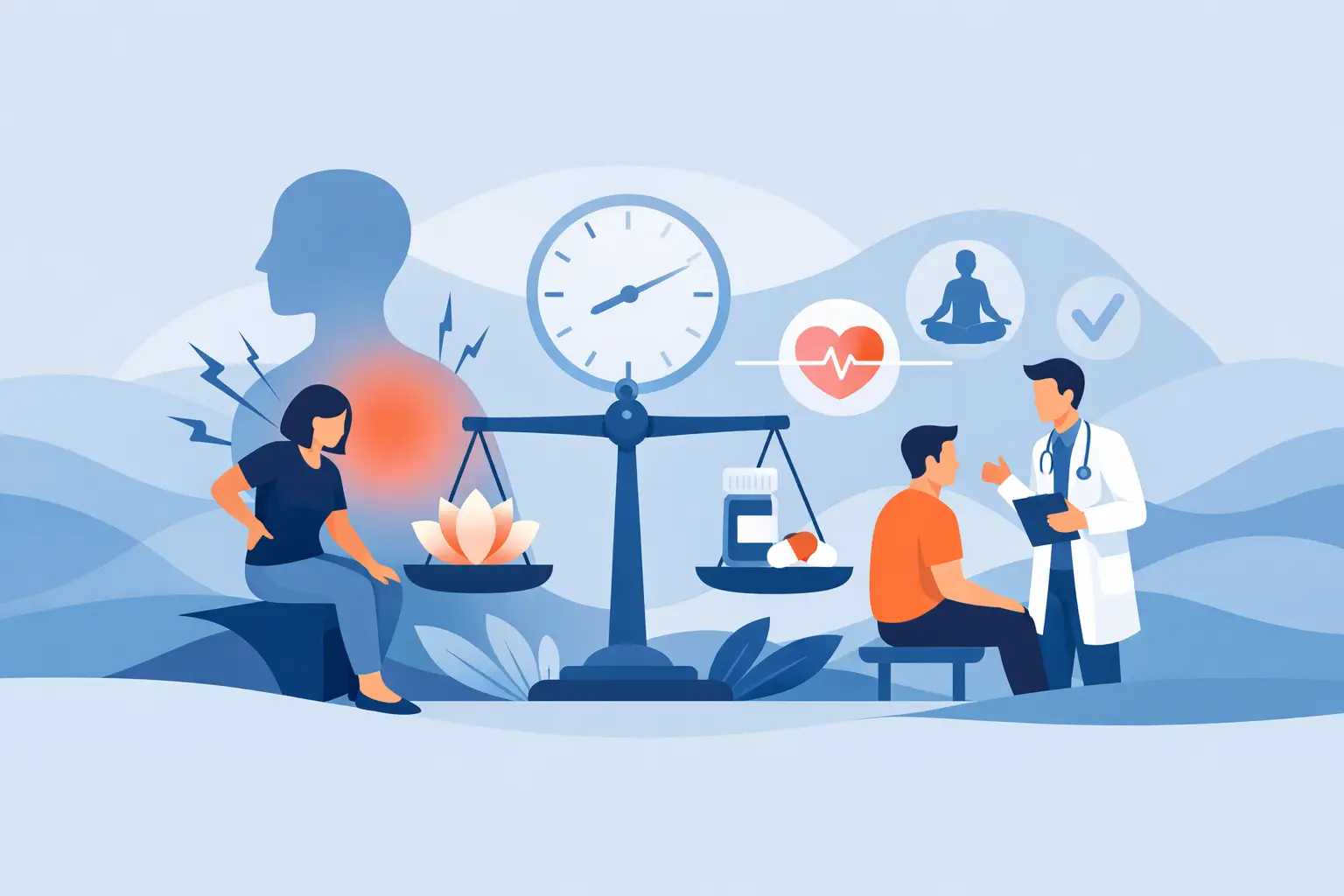
Pain that lingers changes more than a training plan. It can make a familiar lift feel uncertain, turn a long desk day into a calculation, and create hesitation around the activities that usually keep you sharp. This guide to chronic pain management is built for active people who want more than temporary relief: they want a clear path back to capable, confident movement.
Chronic pain is often defined as pain that persists beyond expected tissue healing, commonly for more than three months. That definition is useful, but it does not tell the whole story. Pain can be intense even when imaging is unremarkable, and it can remain present after an injury has healed. It is real, complex, and influenced by the interaction of your body, workload, sleep, stress, previous experiences, and environment.
The aim is not always to eliminate every sensation before returning to life. The more productive goal is to improve capacity, reduce the frequency and impact of flare-ups, and restore trust in your body.
Start with a precise assessment
Chronic pain deserves a more considered approach than simply being told to rest or push through. A high-quality assessment looks beyond the painful area. It considers how symptoms began, what reliably aggravates or eases them, your training history, work demands, recovery habits, movement patterns, and the activities you have started to avoid.
This matters because the same diagnosis can look very different from one person to another. Two runners with persistent Achilles pain may need entirely different plans. One may be under-loading the tendon after months of caution; the other may be stacking hard sessions, poor sleep, and aggressive hill work without enough recovery. The right intervention follows the pattern, not just the label.
A clinician may also determine whether further medical assessment is appropriate. New or worsening weakness, numbness around the groin, changes to bowel or bladder function, unexplained weight loss, fever, significant night pain, or pain following major trauma should be assessed promptly. These signs are uncommon, but they should never be ignored.
Reframe pain without dismissing it
Persistent pain is not a measure of toughness, damage, or failure. It is a protective experience generated by the nervous system when it perceives threat. That perception is shaped by physical input, but also by fatigue, stress, uncertainty, low mood, poor sleep, and the memory of previous flare-ups.
This does not mean pain is "all in your head." It means the system is more sophisticated than a simple damage alarm. If a shoulder hurts during an overhead press, the shoulder still deserves intelligent attention. But the solution may involve more than a local treatment. It may include adjusting volume, rebuilding shoulder strength, improving sleep, changing expectations around symptoms, and gradually practising the movement again.
A useful distinction is discomfort versus danger. During rehabilitation, a mild and predictable increase in symptoms can be acceptable if it settles within a reasonable window and does not progressively worsen your function. Sharp, escalating, unfamiliar, or lingering pain is a signal to reassess the dose. Your care team can help establish personal guardrails rather than relying on a universal pain scale.
Build capacity, not avoidance
Avoidance can provide short-term relief, especially after a severe flare-up. Over time, however, reducing movement too far can lower strength, endurance, coordination, and confidence. The gap between what life demands and what your body feels ready to do becomes wider.
Progressive loading closes that gap. It is the controlled exposure to the movements and forces that matter to you, from carrying a child to completing a deadlift or playing a full tennis match. The starting point must be appropriate, but it should still be meaningful.
Find your current baseline
Choose one or two activities that are relevant to your goal and measurable enough to repeat. This might be a 20-minute walk, a set number of stairs, a modified squat, or time spent at a standing desk. Establish what you can do with manageable symptoms and without a significant next-day setback.
Your baseline is not a verdict on your fitness. It is a starting line. From there, progress one variable at a time: duration, load, range of motion, speed, or complexity. Small increases can feel restrained for a performance-minded person, yet they are often what make consistency possible.
Use pacing as a performance tool
Pacing is not doing less forever. It is distributing effort so that your total workload is sustainable. This is particularly valuable for people caught in the boom-and-bust cycle: a good day prompts a hard workout, extensive housework, or a return to a full sport session, followed by several difficult days.
A better approach is to plan activity before symptoms force a stop. Keep early sessions comfortably repeatable, then increase exposure with intention. If a new training block, a demanding work week, and poor sleep coincide, something else may need to be scaled back. Recovery is part of the programme, not an optional extra.
Train the whole system
Passive care can be useful for short-term symptom modulation, especially when pain has made movement feel inaccessible. Manual therapy, needling, heat, and other modalities may create a window in which you can move more freely. Their value is highest when they support an active plan rather than becoming the entire plan.
Strength training is often central to chronic pain management because it improves physical capacity and provides repeatable evidence that the body can tolerate load. The prescription depends on the person. Heavy, lower-volume work may suit one athlete; controlled endurance work, mobility, balance, or graded exposure to impact may be more appropriate for another.
Cardiovascular exercise also matters. Walking, cycling, swimming, rowing, or running at an appropriate dose can support mood, circulation, sleep quality, and general conditioning. The best modality is usually the one you can perform consistently and progress without triggering a prolonged flare-up.
Movement quality has a place, but perfection is not the objective. Bodies are adaptable, and there is rarely one flawless posture or technique that prevents pain. Instead, aim for options: the strength and control to move well across different positions, loads, and environments.
Respect the recovery inputs
Pain sensitivity often rises when recovery capacity falls. You do not need a perfect lifestyle to make progress, but the foundations deserve the same attention as your exercise prescription.
Sleep is especially influential. A few nights of poor sleep can reduce tolerance for training and make ordinary sensations feel more intrusive. A consistent wake time, a calmer pre-bed routine, and realistic caffeine and alcohol habits can make a material difference over time.
Nutrition should support the work you are asking your body to do. Regular meals, adequate protein, hydration, and sufficient energy intake are particularly relevant for active people who are rehabbing while maintaining demanding careers or training schedules. Under-fuelling is easily mistaken for a lack of resilience.
Stress management is not separate from rehabilitation. High pressure at work, caregiving responsibilities, travel, and a packed calendar all draw from the same recovery budget. This does not mean you must remove stress before you can improve. It means your plan should account for real life rather than compete with it.
Measure progress beyond pain scores
Pain levels are worth tracking, but they are not the only marker that counts. Look for changes in function and confidence: fewer interrupted meetings, a longer walk without guarding, a return to lifting, better sleep, or less time spent thinking about the painful area.
Keep simple notes on activity, symptoms later that day and the following morning, sleep, and major stressors. Patterns usually become clearer after several weeks. This record helps distinguish a true overload problem from the normal variability of persistent pain.
Progress is rarely linear. A flare-up does not erase your gains, and it does not automatically mean that you have reinjured yourself. Treat it as useful information. Review what changed, reduce the next exposure if needed, keep a tolerable level of movement in place, and rebuild from the last sustainable step.
Choose care that connects treatment to your goals
The most effective plan should make sense in the context of your life. If your goal is to ski, train for a race, travel comfortably, or simply finish a workday with more energy, your rehabilitation should reflect that outcome from the beginning.
Look for care that combines clinical reasoning with performance thinking: an assessment that explains the why, hands-on treatment when it is useful, and an exercise progression that evolves as your capacity improves. The standard is not endless appointments. It is greater independence, clearer decision-making, and a body that feels more available to you.
Chronic pain can narrow your world when every choice becomes a risk calculation. A well-designed plan gradually expands it again - one repeatable session, one better recovery decision, and one confident movement at a time.