
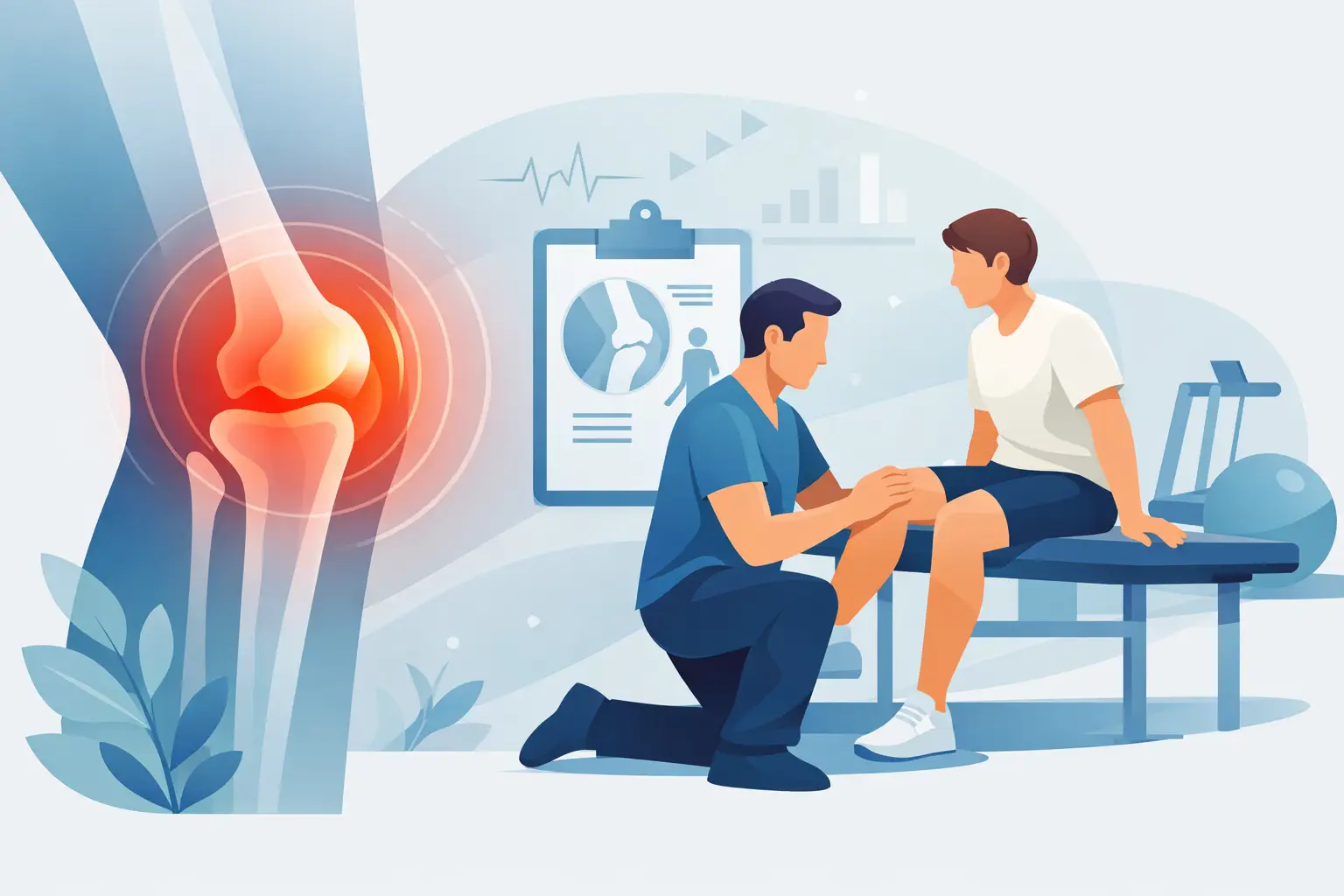
A knee that protests on stairs but feels acceptable on a bike tells a different story from a knee that locks, swells after a twist, or aches only after long runs. A considered guide to knee pain rehabilitation begins there: not with a generic exercise sheet, but with the pattern of your symptoms, your training demands, and the movement capacity you need to restore.
For active adults, rehabilitation should be more ambitious than simply reducing pain. The standard is a knee that can tolerate strength training, sport, travel, workdays, and the unexpected demands of real life with control. That requires precision, patience, and a plan that evolves as your capacity improves.
Start by Understanding What Your Knee Is Telling You
Knee pain is a location, not a diagnosis. Pain at the front of the knee may relate to patellofemoral irritation, tendon sensitivity, or how the hip, ankle, and foot manage load. Pain along the joint line may have a different source. Swelling, instability, mechanical catching, or pain following a direct trauma deserve a more detailed clinical assessment.
The goal is not to become preoccupied with every sensation. It is to identify the variables that change your symptoms. Consider when pain appears, what it feels like, whether swelling follows activity, and how quickly the knee settles. A knee that is mildly sore during a session but returns to baseline by the next day may be tolerating an appropriate training dose. A knee that becomes more swollen, unstable, or painful for several days is likely being asked to do too much.
A high-quality assessment also looks beyond the knee. Hip strength, ankle mobility, trunk control, footwear, previous injuries, training volume, sleep, and recovery all influence how load is distributed. The knee is often where the signal appears, not necessarily where the full problem begins.
Know When Not to Push Through
Training through manageable discomfort can be appropriate in some rehabilitation plans. Training through warning signs is not. Seek prompt medical assessment if you experience any of the following:
- A significant twist or impact followed by rapid swelling
- An inability to bear weight, fully straighten the knee, or perform a straight-leg raise
- True locking, repeated giving way, or a visible deformity
- A hot, red, intensely swollen joint, fever, or calf swelling
These signs do not automatically indicate a serious injury, but they warrant timely evaluation rather than self-directed progression.
The First Phase: Settle Symptoms Without Losing Capacity
Early rehabilitation is an exercise in restraint. Complete rest can reduce symptoms temporarily, but prolonged unloading may leave the knee less prepared for the activity that triggered pain in the first place. The better approach is relative rest: reduce the aggravating dose while maintaining the movement you can tolerate.
For a runner, that may mean temporarily reducing hills, speed work, or total weekly kilometres while keeping easy running within a manageable range. For someone whose knee reacts to deep squats, it may mean adjusting depth, load, tempo, or training frequency rather than abandoning lower-body strength work altogether. Cycling, swimming, controlled sled work, or upper-body conditioning can preserve fitness when appropriate.
Pain is useful feedback, but it is not a perfect damage meter. Many clinicians use a simple monitoring approach: mild discomfort that stays controlled during activity and settles by the next day is often acceptable. The exact threshold depends on the diagnosis, irritability of the condition, and your history. Persistent escalation is a signal to modify the plan.
Symptom management can include ice or heat if either helps you feel more comfortable, but these tools are supportive rather than curative. The durable work comes from restoring strength, movement options, and tolerance to load.
Build Strength That Transfers to Real Life and Sport
A knee does not need endless novelty. It needs progressive exposure to the forces it will eventually face. That usually means strengthening the quadriceps, hamstrings, calves, hips, and trunk while rebuilding confidence in single-leg control.
Quadriceps strength is particularly relevant for many common knee presentations because the quads help manage stairs, deceleration, landing, and changes of direction. Early exercises might include isometric knee extensions, sit-to-stands, step-ups, or supported split squats. As tolerance improves, the programme can progress toward loaded squats, leg presses, split squats, and knee-extension variations.
The right exercise is less about finding a universally “safe” movement and more about matching the movement to your current capacity. A deep squat may be entirely appropriate for one person and too provocative for another. A leg extension machine may be an effective tool when carefully dosed, particularly when quad strength is clearly limited. Context matters more than online rules.
Calf and hip capacity should not be treated as accessories. The calf manages force with every stride and landing, while the hip contributes to control during single-leg tasks. Stronger surrounding tissues do not make the knee invincible, but they give the body more options when demand rises.
Progress Load With Intent
Rehabilitation improves when progression is measurable. Increase one variable at a time: load, range of motion, repetitions, speed, complexity, or frequency. If you add weight to a split squat, there may be no need to also add a deeper range and an extra training day that same week.
Quality remains the gatekeeper. A controlled step-down with a stable pelvis and a knee that tracks comfortably is more valuable than forcing a higher box before you are ready. Good mechanics are not about chasing a perfectly straight line. They are about demonstrating control, confidence, and a movement strategy that does not repeatedly provoke symptoms.
Return to Running, Cutting, and Sport-Specific Demand
The transition from gym rehabilitation to sport is where many setbacks occur. Strength is foundational, but sport asks for more: acceleration, deceleration, repeated impact, reactive changes of direction, and fatigue resistance.
A return-to-running plan should begin with your actual baseline, not your desired timeline. Some people can start with easy continuous running. Others need a run-walk progression or a period of brisk incline walking first. Volume comes before intensity for most runners. Establish a tolerable weekly rhythm, then add distance, pace, hills, and intervals in sequence.
For field and court athletes, reintroduce straight-line running before controlled deceleration, lateral movement, planned cuts, and finally reactive drills. The final stage should resemble the environment you are returning to. A knee that tolerates gym exercises but has not been exposed to high-speed braking is not yet prepared for a competitive match.
Readiness is not one test or one pain-free day. It is a body of evidence: the knee remains calm after training, strength is returning, single-leg tasks look controlled, and sport-specific work can be repeated without a meaningful decline. Psychological readiness matters too. Hesitation is common after pain or injury, and graded exposure is often the most effective way to rebuild trust.
Recovery Is Part of the Prescription
Rehabilitation sits inside the rest of your life. A demanding work week, poor sleep, a sudden spike in training, and under-fuelling can lower your tolerance even when the exercise selection is excellent. This is why the same programme can feel productive one week and excessive the next.
Prioritize sufficient protein and overall energy intake, particularly if you are training while recovering. Protect sleep where possible. Keep an honest view of total load, including recreational sport, long walks, lifting sessions, and weekend activities. The objective is not to make life small while the knee recovers. It is to distribute demand intelligently.
At Orchard, rehabilitation is approached as a return to high-quality movement, not a pause button on the life or sport you value. Clinical treatment can help address pain and movement restrictions, but the long-term result is built through a progressive plan that gives you ownership of your capacity.
When Professional Guidance Changes the Outcome
Self-management can work well for a mild, familiar flare-up that is steadily improving. It is less suitable when pain persists, function plateaus, swelling recurs, or you are preparing to return to a high-demand sport or competition. In those cases, a physiotherapist or sports therapist can assess movement, identify relevant strength deficits, and set progression criteria that fit your goals.
The best plan is rarely dramatic. It is specific enough to challenge you, adaptable enough to respect recovery, and measured enough to show that you are moving forward. Knee rehabilitation is not about avoiding load forever. It is about earning the right to handle it again, with strength and confidence that extend well beyond the next pain-free session.