
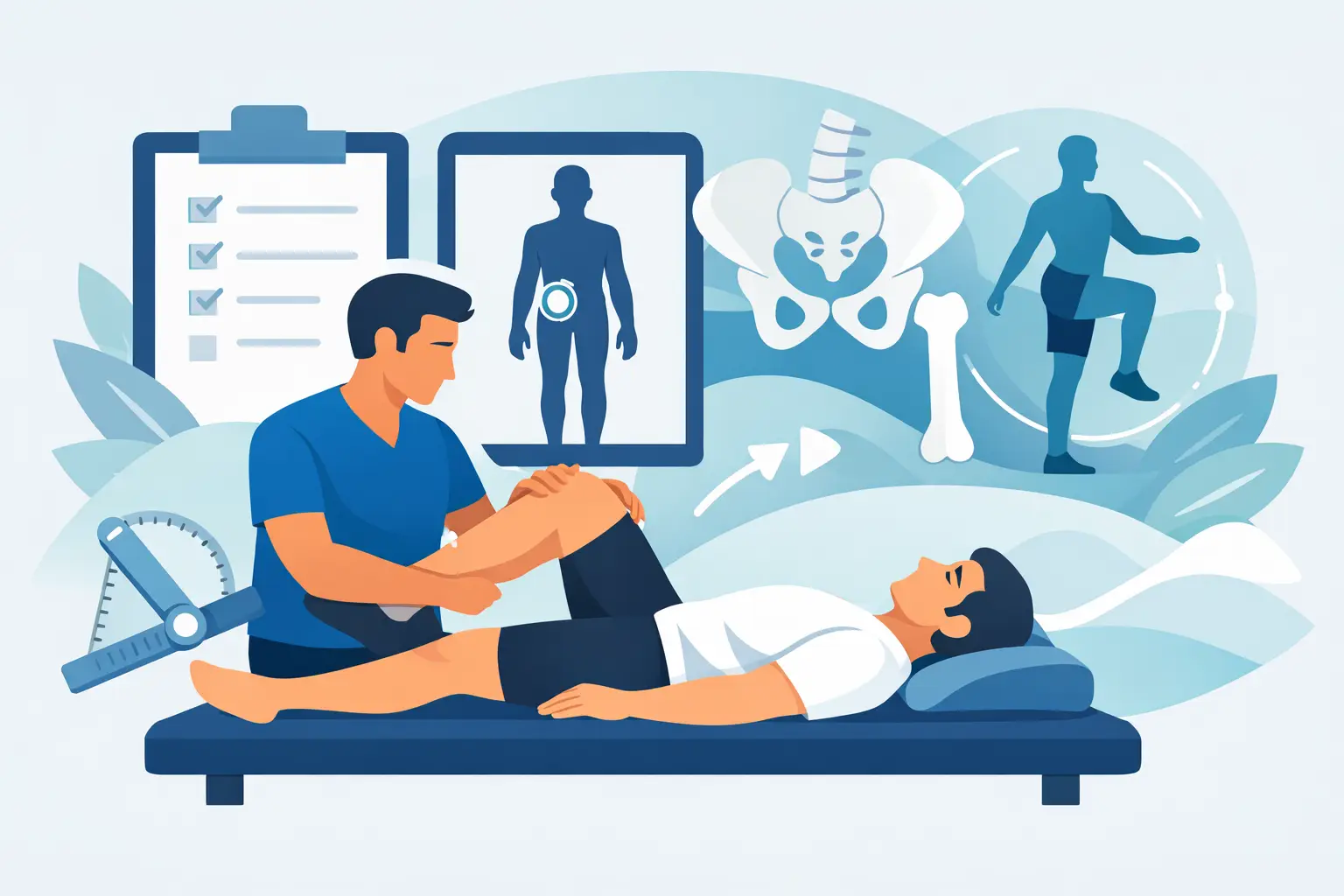
A deep squat tells the truth fast. So does a stiff stride, a pinching front hip, or a deadlift that never feels as clean as it should. A hip mobility assessment is not about chasing flexibility for its own sake. It is about understanding how well your hips can move, control force, and support the demands of training, sport, and daily life.
For active adults, that distinction matters. Plenty of people can stretch their way into more range. Far fewer can use that range with precision under load. When hip motion is limited, poorly controlled, or simply mismatched to the task, the body usually finds a workaround. Sometimes that shows up as lower back tension. Sometimes it becomes knee irritation, reduced speed, or a squat pattern that never quite looks right.
What a hip mobility assessment is really measuring
At a premium level of care, mobility is never reduced to a single number. A hip mobility assessment looks at available range, but also at how that range is accessed, what happens at the pelvis and spine, and whether the surrounding system can stabilize effectively.
The hip is designed for movement in multiple directions - flexion, extension, internal rotation, external rotation, abduction, and adduction. In real performance settings, those motions do not happen in isolation. They are coordinated with breathing, trunk position, foot mechanics, and load management. That is why a simple toe-touch or figure-four stretch tells only part of the story.
A strong assessment asks better questions. Can you create hip internal rotation without the pelvis twisting away? Can you extend through the hip without borrowing from the lower back? Can you absorb force on one leg and maintain alignment? Can you rotate efficiently during running, cutting, or changing direction? The answers shape the plan.
Why hip mobility matters for performance
In high-performing bodies, the hips are a central transfer station. They help produce power, absorb impact, and coordinate movement between the ground and the trunk. If they are not doing that well, other areas often carry the cost.
For runners, limited hip extension can shorten stride mechanics and increase compensations through the lumbar spine. For lifters, reduced internal rotation or flexion may alter squat depth and force the pelvis into less efficient positions. For field and court athletes, poor rotational access can affect acceleration, deceleration, and change of direction.
There is also a recovery argument here. Repeated training on top of unresolved movement restrictions tends to create friction. Not always pain immediately, but often a gradual decline in movement quality, output, or resilience. The earlier a constraint is identified, the more precisely it can be addressed.
What shows up during a hip mobility assessment
A thorough hip mobility assessment usually blends table-based testing with active movement analysis. Passive range can be useful, but active control often matters more. If a joint has range that the nervous system cannot organize well, that range may not transfer into training.
A clinician may assess hip flexion, extension, and rotation in standard positions, but they will also watch how you squat, hinge, lunge, step, and balance. Single-leg tasks are especially revealing because they expose control deficits that bilateral movements can hide.
Hip rotation is often the missing piece
Many active adults assume tight hips mean they need more stretching into flexion. In practice, rotation is often the more relevant variable. Limited internal rotation, in particular, can influence squat mechanics, gait, and pelvic positioning.
That does not mean everyone needs the same amount of motion. Anatomy varies. Hip socket depth, femoral version, injury history, and sport demands all affect what is realistic and useful. A good assessment respects those differences rather than forcing every body toward the same ideal.
Control matters as much as range
This is where many self-assessments fall short. You might have enough passive motion when someone moves the joint for you, but struggle to own that motion when asked to stabilize, breathe, and produce force. That gap between available motion and usable motion is often where performance plateaus and overload patterns live.
If the pelvis shifts during a squat, if the ribcage flares during hip extension, or if one side consistently rotates less than the other, those details matter. They tell you whether the issue is joint restriction, motor control, load strategy, or a combination of all three.
Common signs your hips deserve a closer look
You do not need severe pain to benefit from a formal assessment. Often, the most useful time to look at hip function is when things feel off but not yet injured.
Recurring front-of-hip pinching, chronic glute tightness, lower back tension after training, asymmetrical squat depth, and unstable single-leg work are all common reasons to investigate. So are reduced sprint mechanics, a stride that feels blocked, or a lunge position that never feels strong on one side.
There are also cases where the issue is not mobility at all. Some people feel stiff because they lack strength and control in end range. Others feel restricted because of fatigue, poor recovery, or a training program that loads the same patterns repeatedly. That is exactly why assessment comes before intervention.
What a strong assessment should lead to
The value of a hip mobility assessment is not the test itself. It is the precision that follows. Once the limiting factors are clear, the work becomes far more targeted.
Sometimes the answer is mobility training - controlled articular rotations, positional breathing, capsular work, or progressive end-range loading. Sometimes the missing ingredient is strength, especially in the glutes, adductors, deep rotators, or trunk. Sometimes technique is the issue, and a movement pattern improves once the body is coached into a better strategy.
In a performance setting, the best plans are rarely generic. They are built around your sport, your training history, and the positions you need to own. A desk-based professional who lifts four times a week has different demands than a hockey player, runner, or golfer. The assessment should reflect that.
Self-checks versus professional testing
There is a place for basic self-screening. A bodyweight squat, a split squat hold, a 90-90 hip rotation position, or a single-leg balance test can reveal useful patterns. If one side feels notably blocked, unstable, or painful, that information matters.
But self-checks have limits. Most people cannot easily separate true hip restriction from compensation elsewhere. A stiff ankle can alter a squat. A guarded lower back can mimic a hip problem. Ribcage position and breathing mechanics can change what the hip appears able to do.
Professional testing adds context. It distinguishes structural realities from modifiable limitations and helps avoid wasting time on the wrong fix. For clients who care about efficient progress, that precision is worth it.
The role of pain in a hip mobility assessment
Pain changes movement, but it does not always identify the source. A sore hip flexor may be reacting to a deeper control issue. Glute tightness may be protective rather than primary. Even groin discomfort can come from multiple movement faults depending on the sport and the loading pattern.
That is why pain should be interpreted carefully. Pushing aggressively into painful stretching can aggravate an already sensitive system. On the other hand, avoiding all hip movement can reduce confidence and create more guarding. The right path usually sits between those extremes - enough movement to restore options, enough control to make those options feel safe.
Hip mobility assessment in an elite recovery model
In a conventional rehab setting, the goal may be symptom reduction. In an elite recovery environment, that is only the entry point. The broader objective is to restore high-quality movement that supports performance, resilience, and longevity.
That changes how the hip is evaluated. The question is not only whether the joint moves. It is whether it moves well enough for the life and training you expect from it. Can it support heavier lifts, longer runs, sharper cuts, and cleaner transitions between effort and recovery? Can it tolerate ambition?
At Orchard, that standard aligns with how active clients want to be treated - not as injured people managing limitations, but as capable people refining their physical output with more precision.
What to do if your assessment finds a limitation
Start smaller than your ego wants. The best mobility work is specific, repeatable, and easy to integrate. Ten focused minutes done consistently will outperform random stretching marathons every time.
Keep the goal practical. If you need cleaner squat mechanics, train the ranges and positions that feed that pattern. If running feels blocked, look at extension, rotation, pelvic control, and single-leg stability. If a range improves on the table but disappears under load, shift some attention toward strength and coordination.
Most of all, give the process enough time to work. Some changes happen quickly when the issue is motor control. Structural and long-standing restrictions tend to move slower. Progress should feel measurable, not dramatic.
A well-executed hip mobility assessment gives you something more valuable than a diagnosis of tightness. It gives you direction. And for anyone serious about movement quality, that is where better performance starts.