
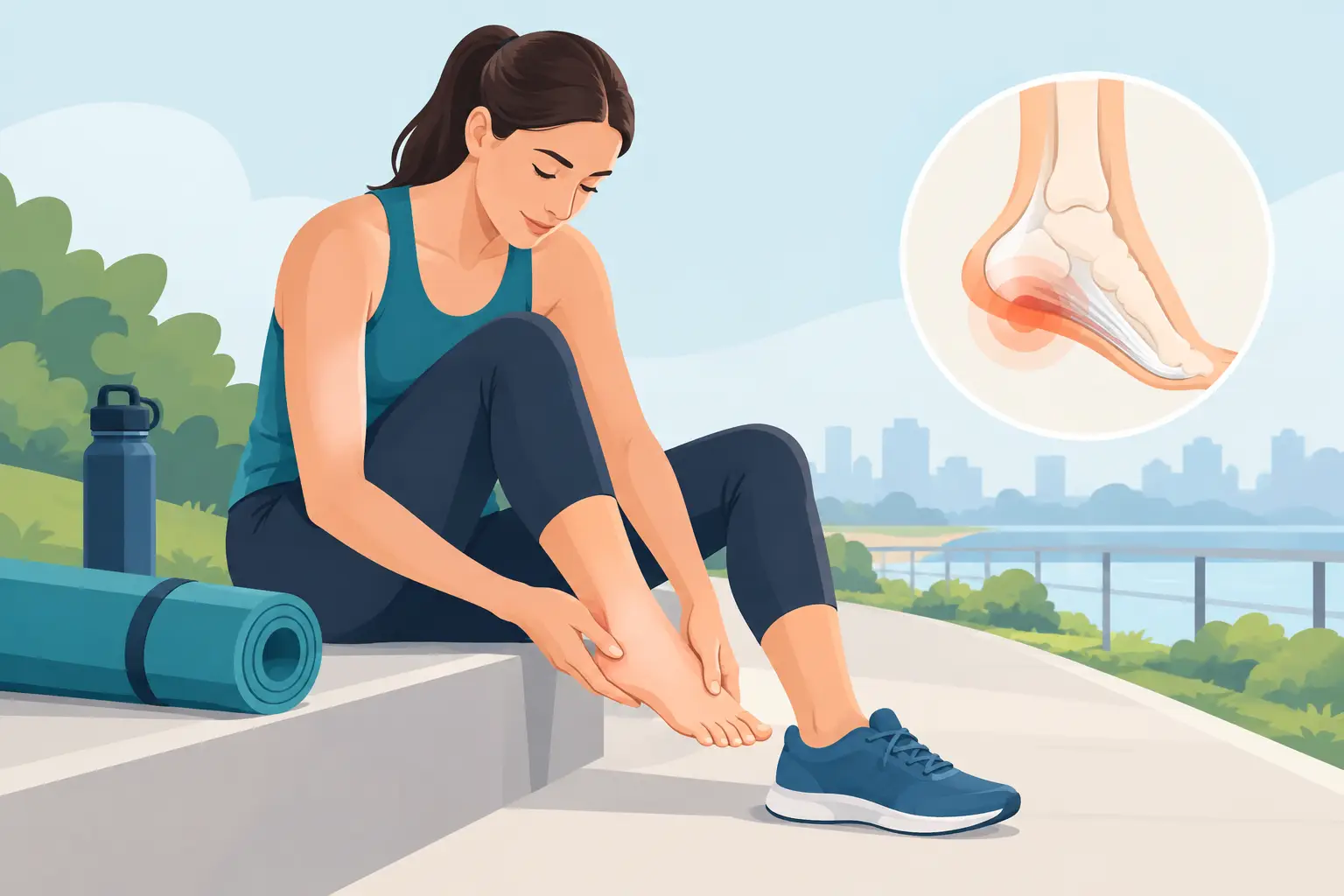
The first steps out of bed should not dictate the standard of your day. Yet for many active people, that sharp heel pain is the first sign that training volume, recovery capacity, or movement mechanics need attention. Learning how to manage plantar fasciitis is not about stopping everything indefinitely. It is about reducing irritation while rebuilding the foot and lower leg capacity that supports your sport, training, and daily life.
Plantar fasciitis can be persistent because the plantar fascia works constantly. This strong band of connective tissue runs along the sole of the foot, helping manage force with every step, landing, climb, and push-off. A high-performance approach respects that reality: protect the tissue from excessive load, then progressively prepare it to tolerate load again.
How to Manage Plantar Fasciitis With Better Load Control
Plantar fasciitis often presents as pain at the inside of the heel, particularly with the first few steps in the morning or after sitting. The discomfort may ease as you move, then return after a long day, a hard workout, or a sudden increase in running, court sport, or walking volume.
Despite the name, this is not always a simple inflammatory issue. In many cases, the fascia has been exposed to more demand than it can currently recover from. That demand can come from an obvious training spike, but it can also build quietly through long days on hard surfaces, a change in footwear, reduced calf strength, poor sleep, or a return to activity after time away.
The goal is not necessarily complete rest. Full shutdown can reduce fitness, stiffness tolerance, and confidence without resolving the underlying capacity issue. Instead, adjust the activities that create a clear pain response. If running aggravates symptoms, you may be able to maintain conditioning with cycling, swimming, rowing, or strength work that does not provoke the heel.
Use your next-morning symptoms as a practical guide. Mild discomfort that settles quickly and does not intensify the following morning can be acceptable during rehabilitation. Pain that becomes sharper, lasts longer, changes your walking pattern, or is noticeably worse the next day is feedback that the previous session exceeded your current tolerance.
Start With the Details Under Your Feet
Footwear is not a cure, but it can change the stress placed on an irritated heel. A supportive shoe with a stable sole, sufficient cushioning, and a comfortable fit may reduce symptoms during the more sensitive phase. This does not mean every person needs a highly structured shoe forever. It means your current footwear should match your current capacity.
Avoid making a dramatic switch to minimalist footwear, flat sandals, or unsupportive house shoes while symptoms are active. The same applies to suddenly spending more time barefoot on tile or hardwood. These changes can be useful for some people later, but they are a substantial loading change for the foot.
Temporary arch support, heel cushioning, or taping can also create a more comfortable window for recovery. Their role is to reduce symptoms enough that you can move well and complete your rehabilitation plan. They should support progressive loading, not replace it.
Morning discomfort can be especially frustrating. Before standing, gently move the ankle through a few comfortable circles and pull the toes back lightly to tension the sole of the foot. This can make those first steps less abrupt. A night splint may help some people with pronounced morning pain, particularly when calf tightness is part of the picture, though it is not essential for everyone.
Build Capacity Through the Foot, Calf, and Hip
Stretching alone is rarely enough. A more complete programme develops the tissues that share load with the plantar fascia, including the foot muscles, calf complex, and the hip and trunk system that influences how force travels down the leg.
Begin with controlled, tolerable work. Calf raises are a central exercise because the calf and plantar fascia work together during walking and running. Start with two-legged raises if needed, progressing toward single-leg raises with slow lowering. The quality of the movement matters: maintain control through the heel, avoid rushing the final portion of the lift, and use pain response to guide volume.
Targeted plantar fascia loading can be valuable as well. One option is a heel raise performed with the toes gently elevated on a rolled towel. This introduces tension through the arch while training the calf. It should feel like purposeful work, not a sharp reproduction of heel pain.
Foot strength deserves equal attention. Simple drills such as short-foot holds, controlled toe lifts, and balance work can improve awareness and control through the arch. For runners and athletes, these drills are not merely corrective exercises. They help refine the foot's ability to accept and transfer force when pace, fatigue, and uneven surfaces enter the equation.
Calf mobility may also be relevant, particularly when ankle dorsiflexion is limited. Gentle calf stretching can be useful, but aggressive stretching into a painful heel is counterproductive. If the heel is highly irritable, focus first on comfortable movement and graded strength rather than trying to force range.
Return to Training Without Restarting the Cycle
The transition back to impact is where many otherwise good rehabilitation plans lose momentum. Feeling better after a week or two does not automatically mean the foot is ready for a long run, a tournament, or a high-volume leg session. Symptoms often settle before tissue capacity has fully caught up.
Reintroduce impact in measured doses. For a runner, that may mean a walk-run format on a predictable surface rather than immediately returning to hills, speed work, or long distances. For a field or court athlete, it may mean straight-line jogging before cutting, repeated accelerations, and jumping. For a strength-focused client, it may mean adjusting plyometrics and loaded carries while maintaining lower-body strength through tolerable variations.
Progress one variable at a time: duration, intensity, terrain, frequency, or technical complexity. Changing all of them in the same week makes it difficult to identify what triggered a flare-up. A concise training record can be surprisingly useful here, especially when work travel, poor sleep, or a major increase in daily steps may be contributing to the total load.
Recovery habits matter because plantar fasciitis rarely exists in isolation from the rest of your training system. Adequate sleep, sensible weekly programming, nutrition that supports training adaptation, and planned lower-intensity days all influence how well tissues recover. The heel may be where you feel the problem, but the solution often extends beyond the heel.
When a Clinical Assessment Is Worth It
A precise assessment is valuable when pain is not improving after several weeks of intelligent load modification, when it repeatedly returns, or when you are preparing for a meaningful performance goal. The right plan depends on your training history, footwear, ankle mobility, calf capacity, gait mechanics, and the specific demands of your sport or workday.
At Orchard, rehabilitation is approached as performance restoration, not passive symptom management. That means identifying what has changed, defining the capacity your lifestyle requires, and building a progression that returns you to it with greater resilience.
Seek prompt medical assessment if you have severe swelling, bruising after an acute injury, numbness or tingling, pain that is constant at rest or at night, or an inability to bear weight. Heel pain has several possible causes, and not every painful heel is plantar fasciitis.
A strong recovery is usually quieter than people expect. It is built through consistent choices: appropriate shoes for the day, a training load you can recover from, and strength work that gives your feet a larger margin for the life and sport you want to pursue. The aim is not simply to make the morning pain disappear. It is to make your next training block feel more durable than the last.