
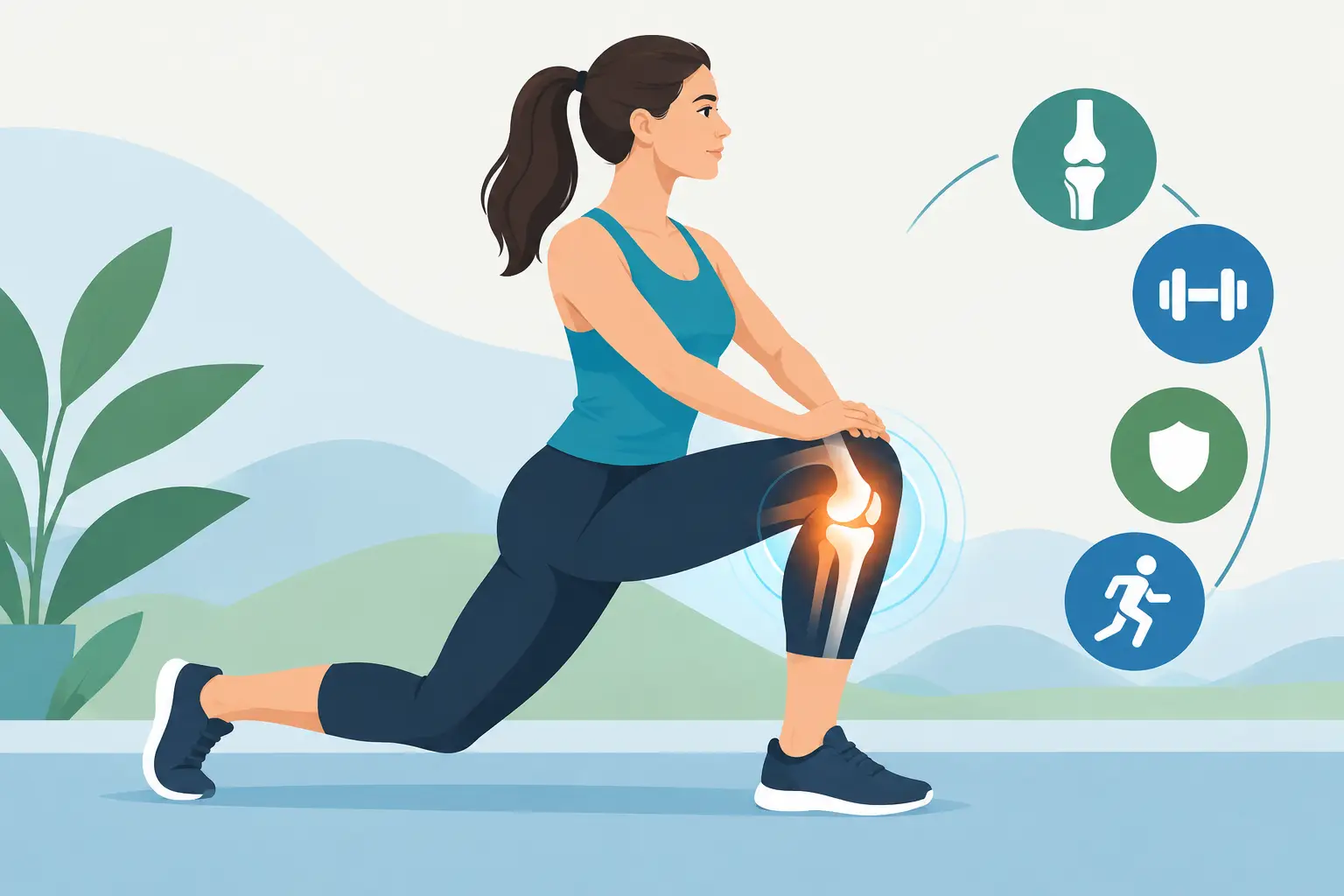
A joint can feel fine during a workout yet still lack the control required for a hard landing, a heavy split squat, or an abrupt change of direction. That gap is where recurring ankle rolls, unstable knees, irritated shoulders, and persistent hip discomfort often begin. Knowing how to rebuild joint stability is not about making a joint rigid. It is about restoring the strength, timing, and confidence to move well under real demand.
For active people, stability is a performance quality. It allows you to produce force without losing position, absorb force without compensation, and return to training with a body that feels capable rather than guarded.
What Joint Stability Actually Means
Joint stability is often reduced to one idea: strong muscles. Strength matters, but it is only one part of the equation. A stable joint depends on passive structures such as ligaments and joint capsule, active support from surrounding muscles and tendons, and the nervous system's ability to sense position and respond quickly.
After an injury, the body can lose more than tissue capacity. It can lose proprioception, the refined awareness of where a joint is in space. This is why an ankle may feel unreliable on uneven ground long after swelling has settled, or why a shoulder can feel hesitant at the bottom of a press despite having full range of motion.
The objective is not to brace every movement or chase perfect stillness. Athletic joints need controlled freedom. Your knee should travel when it needs to travel. Your shoulder blade should move with the arm. Your ankle should adapt to the ground. Stability is the ability to manage that motion with precision.
Start With the Reason the Joint Feels Unstable
Instability has different causes, and the right plan depends on which one is present. A recent ligament injury, repeated sprains, post-operative recovery, generalized hypermobility, poor movement mechanics, and a sudden spike in training volume can all create a similar feeling of mistrust in a joint. They do not require identical rehabilitation.
A thorough assessment should look beyond the painful area. An unstable knee, for example, may be affected by ankle mobility, hip control, quad capacity, trunk positioning, or how quickly the athlete decelerates. A shoulder that feels loose may be influenced by thoracic mobility, rotator cuff endurance, scapular control, or a training program with too much pressing and too little pulling.
This distinction matters because symptoms can be misleading. If a joint repeatedly gives way, locks, visibly shifts, swells after activity, or produces sharp pain, do not treat it as a simple strength deficit. Clinical evaluation is the appropriate starting point. The same applies when instability follows a significant fall, collision, dislocation, or surgery.
How to Rebuild Joint Stability in Layers
The most effective rehabilitation programs progress from local control to full-body performance. Skipping layers may feel ambitious, but it often leaves the joint unprepared for the demands that caused the issue in the first place.
Restore usable range before loading heavily
A joint needs enough movement to distribute force well. Limited ankle dorsiflexion can shift stress into the knee during a squat. Restricted hip motion can encourage the lumbar spine to compensate. A shoulder that lacks comfortable overhead range may force the neck and upper back to take over.
This does not mean aggressively stretching into pain or forcing mobility where the body is protecting an injury. The goal is usable, controlled range. Gentle joint-specific mobility work, soft-tissue treatment where appropriate, and active movements that teach the body to own new range can create a more reliable foundation for loading.
Build local strength and endurance
Once movement is tolerable, strengthen the muscles that directly support the joint. For the knee, this may include quadriceps, hamstrings, calf, and hip musculature. For the shoulder, it often includes the rotator cuff, lower trapezius, serratus anterior, and larger pulling muscles of the upper back. For an ankle, calf strength and the muscles that control inversion and eversion deserve particular attention.
Early loading is often slower and more deliberate than conventional gym training. Isometric holds, tempo repetitions, and controlled single-limb exercises are valuable because they expose deficits in position and endurance. A joint rarely needs only one maximal effort. It needs repeated quality contractions across a session, a match, or a long day on its feet.
Pain is not the only metric. Watch for loss of alignment, shaking that persists despite reduced load, compensation through another body region, or symptoms that are notably worse the following day. These are signals that the current dose may exceed capacity.
Train balance, reaction, and joint awareness
A stable joint must react, not simply hold a position in a quiet room. Balance training is useful because it challenges the nervous system to make small corrections before a larger error occurs. But standing on an unstable surface is not automatically the highest-level option.
The best drills resemble the demands you need to return to. An athlete recovering from ankle instability may progress from controlled single-leg balance to reaches, loaded step-downs, hops, and changes of direction. Someone rebuilding shoulder stability may move from supported cuff work to carries, pressing variations, perturbation drills, and eventually sport-specific overhead loading.
The challenge should be high enough to require attention but controlled enough to preserve good movement. Quality repetitions create better information for the nervous system than chaotic repetitions completed through fatigue.
Reintroduce force and speed
Many rehabilitation plans look successful until speed enters the picture. A knee may tolerate slow split squats yet feel untrustworthy during a quick descent down stairs. A shoulder may handle light pressing but object to a fast tennis serve. This is not failure. It simply means the program has not yet exposed the joint to the relevant force, velocity, or unpredictability.
Progress toward impact, power, and reactive work should be staged. For lower-body joints, that may mean moving from bilateral strength to single-leg strength, then landing mechanics, low-level plyometrics, acceleration, deceleration, and directional change. For upper-body joints, it may mean carries and controlled pressing before faster throws, catches, or overhead sport drills.
The right progression depends on your sport, history, and current symptoms. A recreational runner may need resilient calf and hip capacity more than high-volume cutting drills. A hockey player or basketball athlete needs a more demanding return to lateral force and deceleration.
Load Management Is Part of Stability Training
A perfectly designed exercise plan can still fail when total training load is poorly managed. Joint tissues adapt to progressive stress, not sudden exposure. The common problem is not one challenging session. It is stacking a hard lower-body lift, a long run, a high-intensity class, and poor sleep into the same window when the joint is still rebuilding capacity.
Track how the joint responds over 24 hours, not just during the session. Mild muscular fatigue is expected. Increasing swelling, lingering sharp pain, recurrent giving way, or a steady decline in movement quality suggest the load needs adjustment. Reducing volume, changing exercise selection, or allowing an extra recovery day is not losing momentum. It is protecting the adaptation you are trying to create.
Recovery also has a practical role. Adequate sleep, nutrition that supports training, and sufficient spacing between high-demand sessions improve your ability to build tissue capacity and motor control. Premium rehabilitation is not passive recovery alone. It is a precisely managed relationship between stress and restoration.
Avoid the Shortcuts That Keep Joints Unreliable
Braces and tape can be useful tools, especially during an early return to sport or when risk is temporarily higher. They should not become the only strategy. If external support replaces progressive strength, balance, and exposure to movement, the underlying capacity may remain unchanged.
Similarly, chasing fatigue through endless band exercises is not a complete stability plan. Bands can help establish control, but most active adults ultimately need to tolerate meaningful load. The aim is to graduate from rehabilitation exercises into strength and performance training, not stay in a low-load holding pattern indefinitely.
There is also a temptation to test the joint constantly. Repeatedly provoking a painful movement to see whether it is better can keep the system irritated and reinforce apprehension. Use planned benchmarks instead: cleaner single-leg control, improved tolerance to a specific lift, more confident stair descent, or a progressive return to running volume.
Make Stability Specific to Your Life
The final measure of joint stability is not how polished a drill looks in a clinic. It is whether you can train, travel, work, play, and compete without organizing your life around a vulnerable joint. That requires a plan that reflects your actual demands.
A thoughtful physiotherapy assessment can establish the limiting factor, identify the right loading threshold, and build progressions that fit your training history. For performance-driven clients, the standard should be higher than being pain-free at rest. The target is confident movement when the pace rises and the stakes are real.
Give the process enough time to become durable. When you rebuild stability through intelligent exposure rather than avoidance, the joint can become a platform for stronger, more assured performance.