
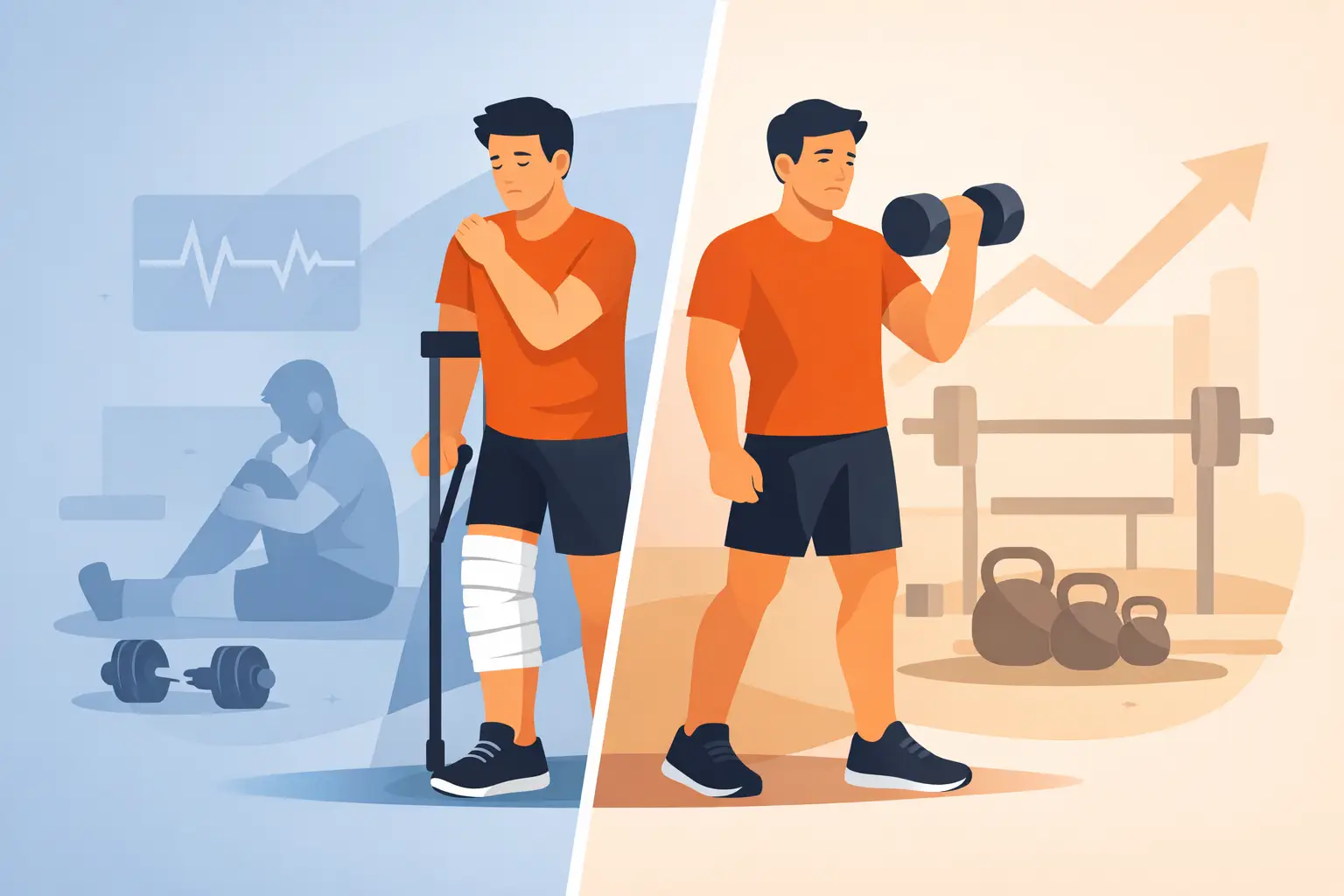
The frustrating part of an injury is rarely the diagnosis alone. It is the sudden distance from the routine that keeps you grounded: your morning run, heavy squat session, weekend league, or the training block you have built around for months. Knowing how to train through injury is not about proving toughness by ignoring pain. It is about protecting the qualities you have earned while giving the injured area the right conditions to recover.
For active people, complete rest can feel like a loss of identity. Sometimes it is necessary. Often, however, the better answer is more precise: adjust the training dose, change the movement, and maintain what can be trained safely. That distinction is where a performance-minded rehabilitation plan earns its value.
How to Train Through Injury Starts With the Right Question
The question is not, "Can I push through this?" It is, "What can I do today that moves recovery forward without creating a setback?"
Pain is information, but it is not a complete diagnosis. A mild, predictable discomfort that settles quickly may be manageable within a structured plan. Sharp pain, a feeling of instability, progressive swelling, altered sensation, or pain that escalates during and after training deserves a different response. The same is true if you cannot bear weight, have obvious deformity, experience fever or unexplained symptoms, or have suffered a significant impact. Those are not training problems to solve with grit. They require timely medical assessment.
For less acute injuries, the goal is usually to find your current capacity. Capacity is not fixed. It changes with sleep, stress, workload, nutrition, training history, and the stage of healing. A skilled physiotherapist looks beyond the painful spot to understand why the tissue became overloaded, what movements are currently tolerated, and which physical qualities need to be retained.
Keep the Engine Running, Not the Injury Angry
An injury to one area does not automatically mean the whole body needs to stop. If a shoulder is irritated, lower-body strength, walking, cycling, or carefully selected conditioning may remain available. If an ankle is limiting running, upper-body training and non-impact cardiovascular work may help preserve fitness. If the back is sensitive, the answer may be a temporary change in loading pattern rather than an indefinite retreat from resistance training.
This is not permission to improvise aggressively. Compensation can be useful in the short term, but it can also create a second problem if technique deteriorates or you shift all demand into another vulnerable area. The aim is not to find the hardest workout you can survive. It is to select training that produces a useful stimulus with an acceptable recovery cost.
A practical approach is to separate your programme into three categories: movements that are clearly tolerated, movements that can be modified, and movements that need to be paused for now. Tolerated work forms the base of your training week. Modified work may involve a shorter range of motion, reduced load, slower tempo, fewer sets, or a different variation. Paused work is not failure. It is a temporary decision that protects the larger objective: a durable return to full performance.
Use Pain as a Guide, Not a Challenge
There is no universal pain score that applies to every person or every injury. Still, a simple monitoring framework is useful. During exercise, symptoms should remain mild and controlled rather than sharp, spreading, or mechanically alarming. After the session, they should settle back toward baseline within a reasonable window, commonly by the next day.
If pain steadily rises set by set, changes the way you move, or leaves you notably worse the following morning, the session was likely beyond your present capacity. Reduce one variable at a time: load, range, volume, speed, frequency, or complexity. This creates usable information. It is far more effective than alternating between heroic sessions and several days of forced inactivity.
Be especially cautious with the temptation to use pain medication simply to complete a session. Medication can have a legitimate role when directed by a health-care professional, but masking symptoms may make it harder to judge how the tissue is responding. Your training decision should be based on function and recovery, not just on whether the discomfort has been temporarily muted.
Protect Training Quality Before Training Volume
When an injury disrupts a programme, many people try to preserve their usual volume at all costs. That is often the wrong priority. High-quality, well-tolerated work is more valuable than accumulating fatigued repetitions with compromised mechanics.
Start by keeping the most important elements of your programme. For a runner, that may mean maintaining aerobic capacity through a bike, pool running, incline walking, or an adjusted run-walk format. For a strength athlete, it may mean preserving exposure to major patterns through alternatives that do not provoke symptoms. For the busy professional who trains to stay resilient, it may mean protecting two or three focused sessions each week instead of chasing a full pre-injury schedule.
Then progress deliberately. Increase one meaningful variable at a time and allow your body to show you the response. Adding load, volume, speed, and frequency in the same week makes it difficult to identify what caused a flare-up. Precision is not slow. It is what prevents the stop-start cycle that delays progress.
Rebuild the Missing Link
Training around an injury is only half the job. The other half is training into a stronger return.
Most injuries are not explained by a single weak muscle or one imperfect movement. They tend to emerge when the demands of training exceed what the body can currently absorb. That gap may involve strength, tendon capacity, joint control, acceleration tolerance, mobility, technique, recovery habits, or simply a rapid spike in workload.
Your rehabilitation work should therefore feel connected to your sport or training goals. A runner with calf pain may need progressive calf loading, single-leg control, and a gradual return to impact. A lifter with shoulder pain may need to restore pressing tolerance while building strength through the shoulder blade, trunk, and upper back. A field athlete returning from a knee issue needs more than a pain-free squat. They need deceleration, change-of-direction, and confidence under fatigue.
The exercises matter, but so does the sequence. Early-stage work may be controlled and local. Later-stage work should look increasingly like the demands you are returning to. The finish line is not simply less pain on a treatment table. It is the ability to perform in the environments that matter to you.
Recovery Is Part of the Loading Plan
High performers often treat recovery as something to optimize after training is complete. During injury rehabilitation, recovery is part of the prescription itself.
Sleep quality, adequate energy intake, protein, hydration, and stress management all influence your ability to adapt. Under-fuelling is particularly common when training volume falls. It may seem logical to eat less while doing less, but tissue repair still requires energy and nutrients. If body composition is also a goal, avoid aggressive restriction while the body is trying to heal.
Your calendar matters too. A demanding work week, travel, poor sleep, and an emotionally stressful period can lower your tolerance for a training progression that felt easy two weeks earlier. Adjusting the plan is not a lack of discipline. It is intelligent load management.
When Expert Guidance Changes the Outcome
Some setbacks are straightforward. Others linger because the diagnosis is unclear, the return-to-training progression is too generic, or the plan does not match the athlete's real demands. If pain is recurring, performance is declining, or you are unsure what is safe, a detailed assessment can replace guesswork with a clear training strategy.
At Orchard, rehabilitation is approached as a return-to-performance process, not a passive wait for symptoms to disappear. The standard should be more than being able to get through daily life. For someone who values training, sport, and long-term capability, the goal is to return with better options, better control, and a more resilient system.
An injury may require you to train differently for a season. It does not have to take you away from the athlete you are becoming.