
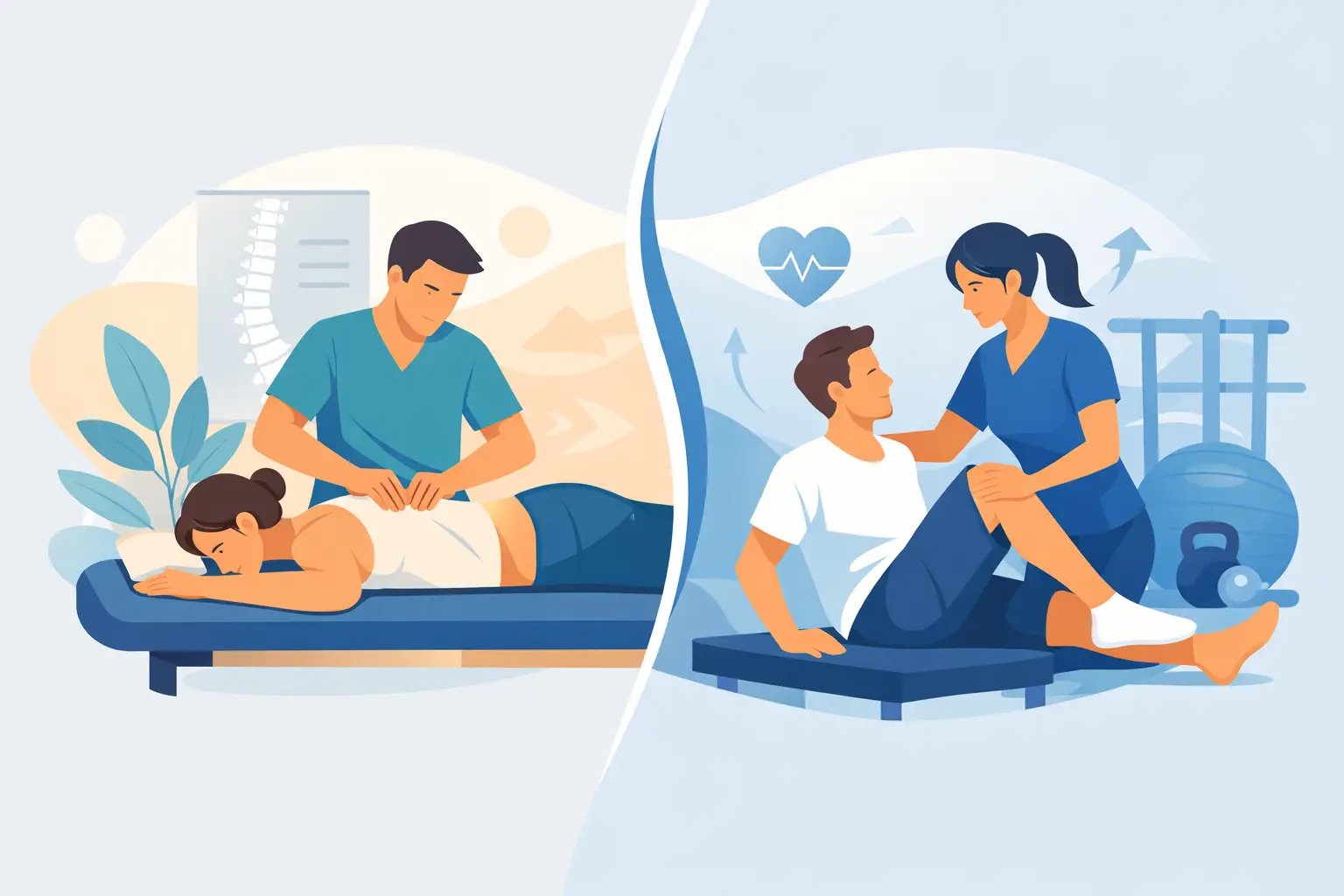
A stiff hip after heavy squats, a shoulder that will not settle between tennis sessions, or recurring low-back pain at your desk can all raise the same question: osteopathy versus physiotherapy - which is the better choice? For active people, the right answer is rarely about choosing the more fashionable treatment. It is about finding care that identifies what is limiting your movement, respects your training goals, and gives you a clear route back to performance.
Both disciplines may use hands-on treatment and both can help people manage pain. Their philosophy, assessment process, scope, and approach to exercise can differ meaningfully. That difference matters when your objective is not simply to feel better for a day, but to build capacity for the demands ahead.
Osteopathy versus physiotherapy: the central difference
Physiotherapy is a regulated health profession across Canada. A physiotherapist assesses movement, pain, strength, mobility, balance, and function, then develops a treatment plan that may combine education, manual therapy, exercise prescription, load management, and progressive rehabilitation. The goal is usually practical and measurable: restore function, reduce symptoms, and prepare the body for the activities that matter to you.
Osteopathy is generally centred on a whole-body, hands-on model of care. Practitioners often look at how joints, muscles, connective tissue, posture, breathing, and movement patterns may be influencing a complaint. Treatment commonly involves manual techniques intended to improve mobility and reduce tissue sensitivity.
There is an important Canadian distinction. The term “osteopath” can refer to different types of practitioners, and regulation varies by province. In many Canadian settings, a manual osteopathic practitioner is not a physician. Osteopathic physicians, or DOs, follow a different medical training pathway and are more common in the United States. Before booking, ask about the provider’s education, credentials, regulatory status where you live, and the type of treatment they offer.
For a client, the practical question is less about labels and more about the clinical plan. Does the practitioner perform a thoughtful assessment? Can they explain why your symptoms may be occurring? Do they have a credible strategy for returning you to running, lifting, golf, work, or sport?
How assessment and treatment may feel different
A physiotherapy assessment is often highly task-focused. If your knee hurts while running, your physiotherapist may examine the knee, but they will also consider training volume, hip and ankle control, calf strength, footwear, running mechanics, sleep, recovery, and the way symptoms respond to load. If your shoulder is painful overhead, the assessment may include range of motion, strength, thoracic mobility, gym programming, and the demands of your sport or work.
Treatment may include hands-on techniques, but it should not end there. Manual therapy can be useful for reducing pain, improving confidence with movement, or creating a short-term window for better training. The longer-term work often involves targeted exercise and progressive exposure to the movements you need. A tendon does not become more resilient because it was treated once. It adapts through appropriately dosed loading over time.
Osteopathic sessions may place greater emphasis on manual assessment and treatment across multiple body regions. Someone with neck tension, for example, may receive work around the upper back, ribs, jaw, shoulders, or diaphragm as well as the neck itself. For some people, this broader and more tactile style of care feels restorative, especially when pain is accompanied by general stiffness or a sense of being physically run down.
That does not mean one model is automatically more comprehensive. A skilled physiotherapist can assess the body as an integrated system, and a skilled osteopathic practitioner can incorporate exercise and movement advice. Individual expertise matters more than a profession’s stereotype.
When physiotherapy is often the stronger fit
Physiotherapy is often the clearest choice when you have a defined injury, a return-to-sport objective, or a performance problem that requires structured progression. Think of an ankle sprain before ski season, an ACL reconstruction, Achilles pain during half-marathon training, or recurring back symptoms under a barbell.
These situations usually benefit from a plan that tracks objective change. That could mean restoring knee extension after surgery, increasing single-leg calf endurance, rebuilding deceleration control, or gradually returning to sprint volume. The treatment should evolve as your capacity improves rather than keeping you dependent on passive care.
Physiotherapy can also be especially valuable when symptoms are affecting your training decisions. A good clinician helps you distinguish between discomfort that can be trained around and warning signs that require a change in plan. Instead of defaulting to complete rest, you can often preserve fitness by modifying range, volume, intensity, exercise selection, or frequency.
For active adults, this is where rehabilitation becomes more than injury management. It becomes a performance strategy: identifying the weakest link, building tolerance deliberately, and returning to the activity with more confidence and better options than before.
When osteopathy may be a useful addition
Osteopathy may appeal if you value hands-on treatment and want support for generalized restriction, recurring tension, or discomfort that does not feel isolated to one joint. Some clients find manual care helpful in the early stages of a flare-up, when pain has made normal movement feel guarded or unfamiliar.
It can also sit alongside a broader rehabilitation plan. For example, an athlete working through a mobility limitation may appreciate the temporary symptom relief that manual treatment provides, while still following a progressive strength and conditioning program. In that scenario, the treatments are not competitors. They serve different roles.
The trade-off is that manual treatment alone is rarely enough for a durable return to high-demand activity. If your goal is to tolerate a full tennis season, run a faster 10K, or lift heavier without recurring pain, your plan should eventually include the specific physical qualities those goals demand: strength, coordination, mobility where it is truly needed, and sensible load exposure.
Be cautious of any provider who presents one technique as a universal answer, promises to permanently “realign” your body, or cannot explain how treatment will translate to your real-world goals. The body is adaptable, not fragile. Quality care should make you more capable, not more fearful of movement.
Choosing care for your body and your goals
Start by defining the outcome. “I want my shoulder fixed” is understandable, but it is not specific enough to guide a premium rehabilitation plan. A more useful target is: “I want to press overhead three times a week without pain,” or “I want to finish a 90-minute soccer match and trust my hamstring at top speed.”
Then look for a clinician who can connect the assessment to that outcome. Ask how they will measure progress, whether they use exercise as part of care, how they will modify your existing training, and what a successful discharge plan looks like. Their answers should feel precise without being overly rigid.
Credentials deserve attention, but rapport matters too. You should leave an assessment with clarity: what may be driving the problem, what you can continue doing, what needs to change temporarily, and what the next stage of recovery requires. If you are an athlete or highly active professional, choose someone who understands the physical and psychological cost of being told to stop everything.
At Orchard, the standard is to treat the immediate issue while keeping the bigger performance picture in view. That means respecting pain, without allowing pain alone to define your potential.
The best choice is often a plan, not a label
Osteopathy versus physiotherapy is not a contest with a universal winner. Osteopathy may offer a hands-on experience that helps you feel less restricted and more comfortable moving. Physiotherapy often provides the clearest framework for rehabilitating injury, rebuilding capacity, and returning to sport or training with measurable progression.
If you choose either route, look beyond the treatment table. The care that earns your time should leave you with a stronger understanding of your body, a realistic plan for the week ahead, and a growing sense that your movement is becoming more capable - not merely temporarily quieter.