
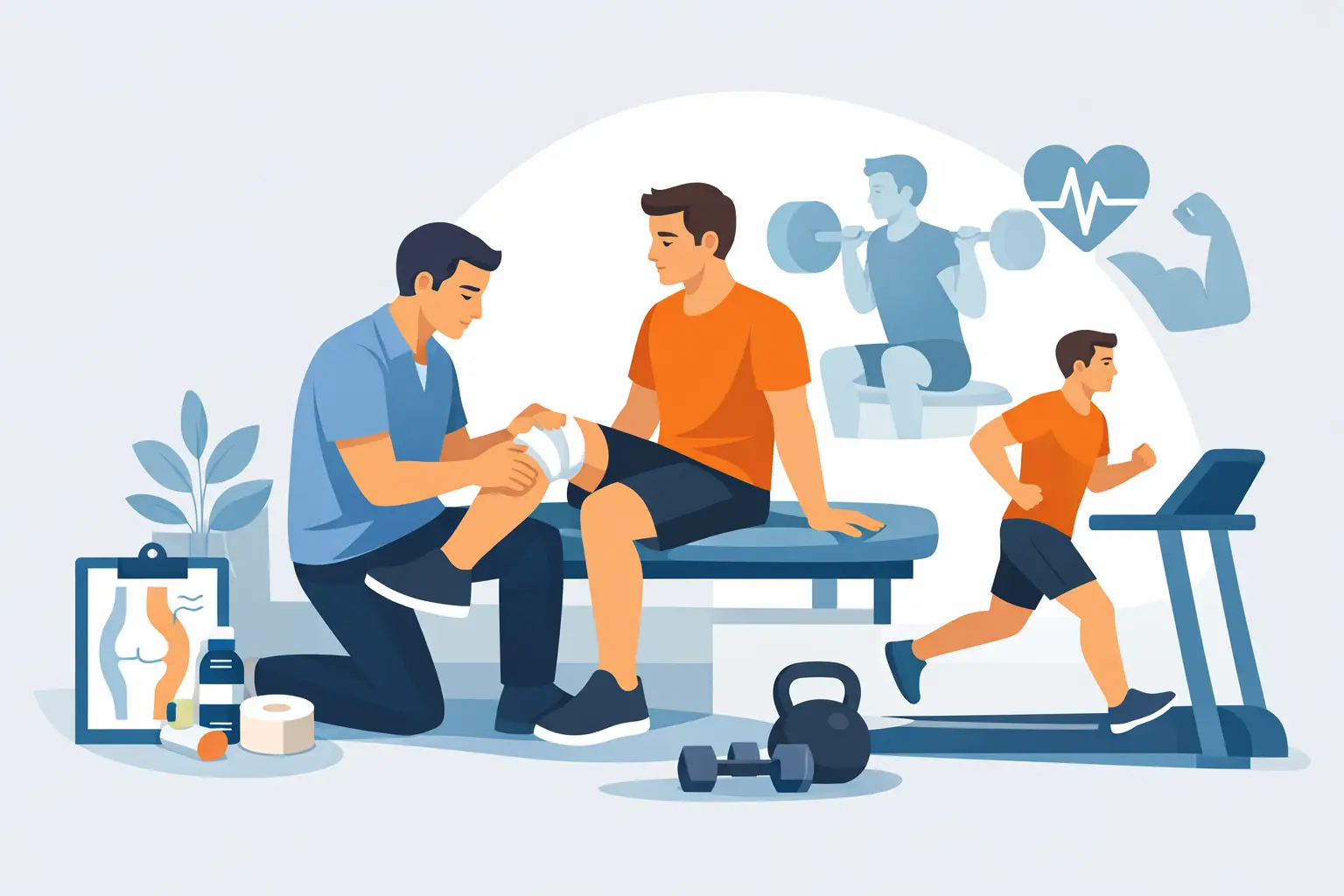
You felt it on a rep that should have been routine - a sharp pull in the shoulder on press, a pinch in the hip at the bottom of a squat, a back spasm during a deadlift warm-up. Most gym injuries do not arrive with drama. They start as a warning, then become the thing that changes how you train, sleep, and move through the day. That is where physio for gym injuries matters most - not as generic rehab, but as a precise return-to-performance strategy.
For active adults, the goal is rarely just to be pain-free. It is to get back under the bar with confidence, rebuild capacity, and avoid repeating the same pattern three months later. That requires more than rest, massage, or a handout of basic stretches. It requires a clear read on why the injury happened, what is still loading poorly, and how to progress without losing momentum.
What physio for gym injuries should actually do
The standard version of rehab often treats pain like an isolated event. A sore shoulder gets shoulder exercises. A cranky knee gets told to stop squatting for a while. Sometimes that is enough for a mild flare-up, but it is rarely enough for people who train seriously and expect their bodies to perform.
High-level physiotherapy looks at the full training picture. Load, technique, mobility, strength balance, tissue tolerance, recovery habits, and exercise selection all matter. The question is not only where it hurts. The better question is what your body stopped tolerating, and why.
That shift changes the quality of care. Instead of simply calming symptoms, physio for gym injuries should help restore movement options, rebuild force production, and create a path back to lifting, running, or classes with control. The work is clinical, but the outcome is performance.
The most common gym injuries and what they usually mean
Not every injury is caused by poor form, and not every painful lift needs to be avoided forever. Most gym-related issues sit in the middle - a mix of load error, fatigue, mobility restriction, programming mismatch, or accumulated irritation.
Shoulder pain during pressing or pulling
Shoulder issues often show up during bench press, overhead work, dips, pull-ups, or high-volume accessory training. Sometimes the problem is local irritation around the rotator cuff or bursa. Sometimes the shoulder is compensating for limited thoracic movement, poor scapular control, or an aggressive jump in pressing volume.
This is why blanket advice can miss the mark. One athlete needs temporary load reduction and cuff strengthening. Another needs better ribcage and shoulder blade mechanics. Another is simply trying to push through too much fatigue. The right plan depends on the pattern, not the body part alone.
Low back pain with deadlifts and squats
Back pain is one of the most common reasons people step away from training, often unnecessarily. In many cases, the issue is not that deadlifts or squats are inherently bad. It is that the tissues are no longer tolerating the current demand.
That demand could come from poor bracing, limited hip contribution, training too close to failure too often, or returning to heavy lifting too fast after time off. Good rehab does not turn the spine into something fragile. It improves your capacity to handle load again, with cleaner progression and less guesswork.
Knee pain in squats, lunges, and jumping work
Knee pain can come from patellar tendon irritation, tracking issues, poor ankle mobility, quad weakness, or simply too much intensity stacked too quickly. A knee that hurts in deep flexion does not always need to avoid squats. It may need a temporary change in range, tempo, stance, or volume while strength and tolerance are rebuilt.
This is where precision matters. Rest alone may reduce symptoms, but if the knee is not prepared for the same demand when you return, the cycle repeats.
Hip pain and pinching
Hip discomfort during squats, hinging, or running often gets dismissed as tightness. Sometimes that is partly true. But pinching, stiffness, and loss of power can also reflect poor pelvic control, limited rotation, overloaded hip flexors, or a movement strategy that keeps forcing the same joint position.
The answer is rarely to stretch harder. More often, it is to improve joint control, broaden available movement, and adjust how load is distributed through the lift.
Why rest alone rarely solves the problem
Rest has a place. Acute irritation needs to settle. Pain that is highly reactive may need a short reduction in load. But complete rest is usually a pause, not a solution.
If you stop training without addressing the underlying limitation, you often return deconditioned, more cautious, and still vulnerable to the same trigger. This is why gym injuries become recurring problems. The tissue calms down, but the system that created the overload never changes.
Effective physio keeps one eye on symptoms and the other on capacity. You may need to reduce barbell loading for a phase, but that does not mean stopping everything. Often there is a better route - changing tempo, range, variation, volume, or training split so the body can recover while still adapting.
What a premium rehab approach looks like
For people who care about training quality, rehab should feel as considered as a strong performance program. That starts with assessment.
A thorough assessment goes beyond pain provocation tests. It should look at how you squat, hinge, press, rotate, and stabilize under real demands. It should account for your lifting history, current programming, recovery capacity, previous injuries, and performance goals. The goal is not to diagnose for the sake of a label. It is to build a treatment plan that matches how you actually train.
From there, treatment should be layered. Hands-on therapy can be useful when it helps reduce guarding, improve comfort, or create a short-term window for better movement. But it should not be the whole model. Exercise therapy, movement retraining, strength progression, and load planning are what create durable change.
At a high standard, rehab also respects psychology. Athletes and committed gym-goers do not just lose function when they are injured. They lose rhythm, identity, confidence, and stress relief. A strong clinician understands that and gives you a plan that feels active, not passive.
How physio for gym injuries bridges rehab and performance
The best return-to-gym programs do not separate rehab from training. They blend them.
That might mean replacing a painful barbell back squat with a heel-elevated goblet squat and controlled split squat work for two weeks. It might mean using landmine press variations while rebuilding overhead tolerance. It might mean reintroducing deadlifts through blocks, then tempo work, then heavier pulls as your symptoms stabilize and confidence returns.
This approach works because it honours both biology and behaviour. Tissues need progressive loading to recover their tolerance. At the same time, active people need continuity. When rehab feels relevant to training, adherence improves and outcomes tend to improve with it.
At Orchard, that bridge between clinical precision and elite recovery is what sets the experience apart. The standard is not basic injury management. It is helping clients move, train, and perform at a higher level than before the setback.
When to seek physio instead of waiting it out
Some gym injuries settle quickly. Others become expensive in lost time because people wait too long. If pain is changing your technique, limiting range of motion, reducing strength, or lingering beyond a week or two, it is worth assessing early.
The same applies if symptoms keep returning whenever training intensity rises. Recurrent shoulder pain on press day, repeated back tightness after hinge sessions, or a knee that flares every time volume climbs is a sign that your current system is not resolving the issue.
Early treatment does not always mean a longer rehab process. In many cases, it shortens it. Catching a load-management problem early is far easier than rebuilding around months of compensation and frustration.
What to expect from recovery timelines
This is where honesty matters. Recovery is not linear, and no good clinician should promise a fixed date after one session. Mild irritations may improve within a few weeks. Tendon-related pain, more reactive joints, or issues that have been present for months often take longer.
What matters most is direction. Are symptoms less reactive? Is movement quality improving? Can you tolerate more load, more range, or more training density than before? Those are the markers that count.
A smart plan also accepts that short-term modification is not failure. Pulling back from one lift for three weeks to protect the next three years of training is usually a good trade.
The strongest athletes are not the ones who never get hurt. They are the ones who respond well when something goes off track. If your training has been narrowed by pain, physio for gym injuries should do more than get you through the week. It should restore the confidence, capacity, and movement quality that let you train hard with fewer compromises.