
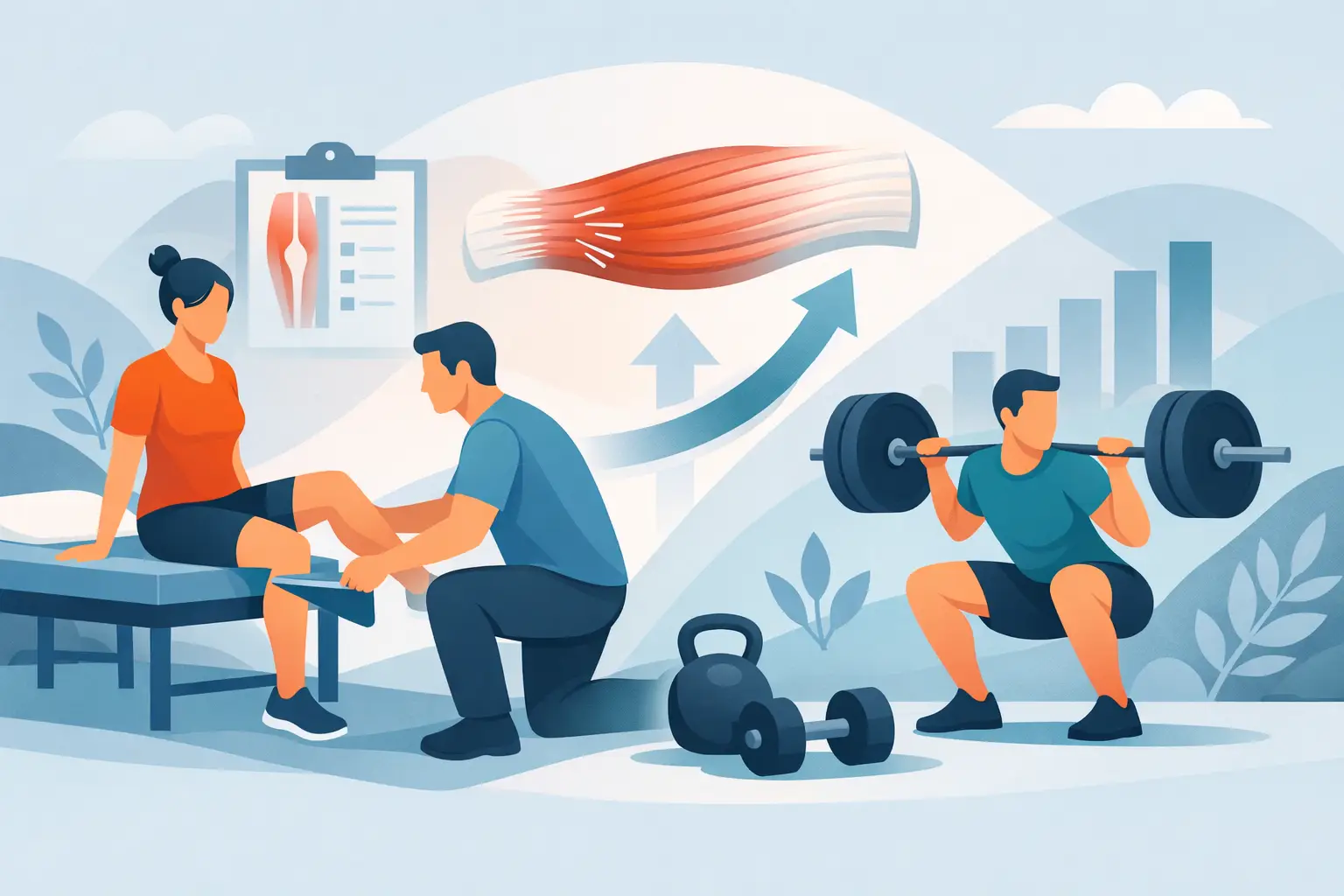
A tendon rarely fails because of one hard session. More often, it becomes irritable when the demand placed on it outpaces its current capacity to recover and adapt. Effective rehab for tendon overload closes that gap with a measured return to strength, speed, and confidence - not an extended retreat from the activities that matter to you.
For runners, lifters, court-sport athletes, and active professionals, tendon pain can feel particularly disruptive. The Achilles that protests on morning stairs, the patellar tendon that reacts after squats, or the elbow that flares during a busy training block can make even a strong body feel unreliable. The answer is not usually to stop moving altogether. It is to load with more precision.
Why tendon overload demands a different approach
Tendons transfer force between muscle and bone. They are built to tolerate substantial load, but they adapt more gradually than the cardiovascular system or muscle tissue. That distinction matters. You may feel fit enough for a new volume of hill running, heavier lifting, or more frequent tennis, while the tendon is still catching up.
Overload can emerge after an obvious spike in training, such as adding sprint work to an already demanding gym routine. It can also build quietly through smaller changes: reduced sleep, a heavier work schedule, a change in footwear, less recovery between sessions, or a sudden return to sport after time away.
Pain is a useful signal, but it is not a complete measure of tissue health. Some tendons are painful yet capable of loading. Others feel manageable during activity but react sharply the following morning. A high-quality assessment looks beyond the pain score to understand the pattern: what provokes symptoms, how long they settle, where capacity has dropped, and which movement or training variables are driving the issue.
The goal of rehab for tendon overload
The goal is not simply to make the tendon quiet. It is to create a tendon and surrounding system that can tolerate the demands you want to place on it.
That includes local tendon capacity, but it also includes calf or hip strength, coordination, landing mechanics, joint range of motion, training structure, and recovery quality. For an Achilles issue, the foot, ankle, calf, and running exposure all matter. For patellar tendon pain, the knee is only one part of the picture. Hip control, quad capacity, jumping volume, and the way an athlete accumulates fatigue may all influence the outcome.
This is why a generic exercise sheet can fall short. Two people may have the same diagnosis but need very different loading plans. A recreational runner preparing for a half marathon needs a different progression than a basketball player entering playoffs, even if both have patellar tendon symptoms.
Start by reducing irritation, not eliminating all load
When a tendon is highly reactive, the first move is often to adjust the training dose. This may mean temporarily reducing the volume of jumping, sprinting, steep hills, deep knee-flexion work, gripping, or other high-demand movements. It does not automatically mean complete rest.
A well-chosen isometric exercise - a sustained muscle contraction without visible joint movement - can be useful early in some cases. It may help settle pain while maintaining a connection to the affected area. For example, a person with patellar tendon pain may use controlled knee-extension holds; someone with Achilles symptoms may begin with calf-raise holds at an appropriate range.
These exercises are not a shortcut or a cure. They are a bridge. The larger objective is to restore tolerance to progressively heavier and faster work.
A practical guide is the tendon’s response over the next 24 hours. Mild, manageable discomfort during exercise can be acceptable when it settles promptly and does not produce a clear increase in next-morning pain or stiffness. A sharp escalation, altered movement, or symptoms that remain elevated into the next day suggests the session exceeded current capacity. The correct adjustment may be less volume, less range, lower intensity, or more recovery between exposures.
Build strength before demanding speed
Tendon rehabilitation typically progresses from controlled strength work toward the specific forces required by sport and life. The sequence matters.
Establish heavy, controlled capacity
Once symptoms are sufficiently settled, slow resistance training becomes central. Depending on the tendon involved, this may include calf raises, split squats, step-ups, leg extensions, hamstring work, rows, presses, or wrist-loading patterns. The load, range, tempo, and frequency should reflect both the tendon’s tolerance and your broader training demands.
Heavier strength work gives the tendon and muscle unit a reason to adapt. It also restores the confidence that often fades after weeks of protecting a painful area. The right dose should feel purposeful. It should not be so easy that it changes nothing, nor so aggressive that it repeatedly triggers a flare.
Reintroduce energy-storage demands
Running, jumping, cutting, throwing, and fast changes of direction place a different kind of demand on tendons. These movements require the tissue to store and release energy quickly. They should be reintroduced only when foundational strength and day-to-day tolerance are improving.
For a runner with Achilles tendon overload, this may begin with a carefully managed return to flat running before hills, faster intervals, or high mileage. For a volleyball athlete with patellar tendon pain, it may progress from controlled landing drills to low-level hops, then more demanding jump contacts and game-like movement.
The progression is rarely perfectly linear. Travel, poor sleep, a demanding work week, or an unexpectedly intense sport session can change the response. That does not mean the plan has failed. It means the next exposure needs to account for the reality of the full load picture.
Training load is part of treatment
Rehab happens between appointments. A precise plan considers the total stress placed on the body, not just the exercises performed in clinic.
If you are lifting four days per week, running twice, and playing a high-intensity sport on weekends, adding a tendon program without modifying anything else can create more demand rather than more recovery. Conversely, removing every meaningful stimulus for months can leave the tendon underprepared for the return to activity.
The most effective plan is often one that protects a few priorities. Keep the training that supports your identity and goals where possible, reduce the movements currently exceeding capacity, and build back the missing qualities with intention. This preserves fitness, motivation, and momentum while the tendon adapts.
Recovery has a place here, though it is not a substitute for progressive loading. Sleep, nutrition, stress management, and sensible spacing between hard sessions influence how well a tendon responds. Passive treatments may provide short-term symptom relief for some people, but they do not replace the work of rebuilding capacity.
Measure progress beyond pain
A tendon can improve before it feels perfect, and it can occasionally feel sore during a productive return to training. Progress is better assessed through several markers: reduced morning stiffness, improved tolerance to daily activity, stronger performance in key exercises, a calmer 24-hour response, and the ability to return to sport-specific tasks.
This broader view prevents two common mistakes. The first is progressing too fast because pain has briefly eased. The second is becoming overly cautious because mild symptoms remain despite clear gains in strength and function.
At Orchard, rehabilitation is designed as a performance process rather than a waiting room between injury and activity. Assessment informs the plan, loading drives adaptation, and each phase is built around the demands you intend to return to.
When tendon pain needs further assessment
Not every painful tendon should be self-managed. Sudden loss of strength, a pop, significant swelling or bruising, inability to bear weight, a visibly altered tendon shape, or symptoms that continue to worsen warrant prompt clinical assessment. Persistent pain that has not responded to sensible load modification also deserves a closer look.
A thorough evaluation can distinguish tendon overload from other contributors, including joint, nerve, bone, or referred pain. It can also identify the movement and training patterns that a label alone cannot explain.
The best return is not the first session you survive. It is the point at which your tendon can support the training, sport, and everyday intensity you value - repeatedly, confidently, and without requiring your life to shrink around it.