
A knee can look good on paper and still fail under pressure. That is the gap return to sport testing is designed to close.
For athletes and active adults, the question is rarely whether pain has settled. The real question is whether the body can handle speed, impact, fatigue, and decision-making when stakes rise. A jog around the block is not the same as a hard cut in football, a loaded landing in volleyball, or a fast break in basketball. Return to sport testing brings precision to that moment. It replaces guesswork with data and helps ensure that rehab has translated into real performance capacity.
What return to sport testing actually measures
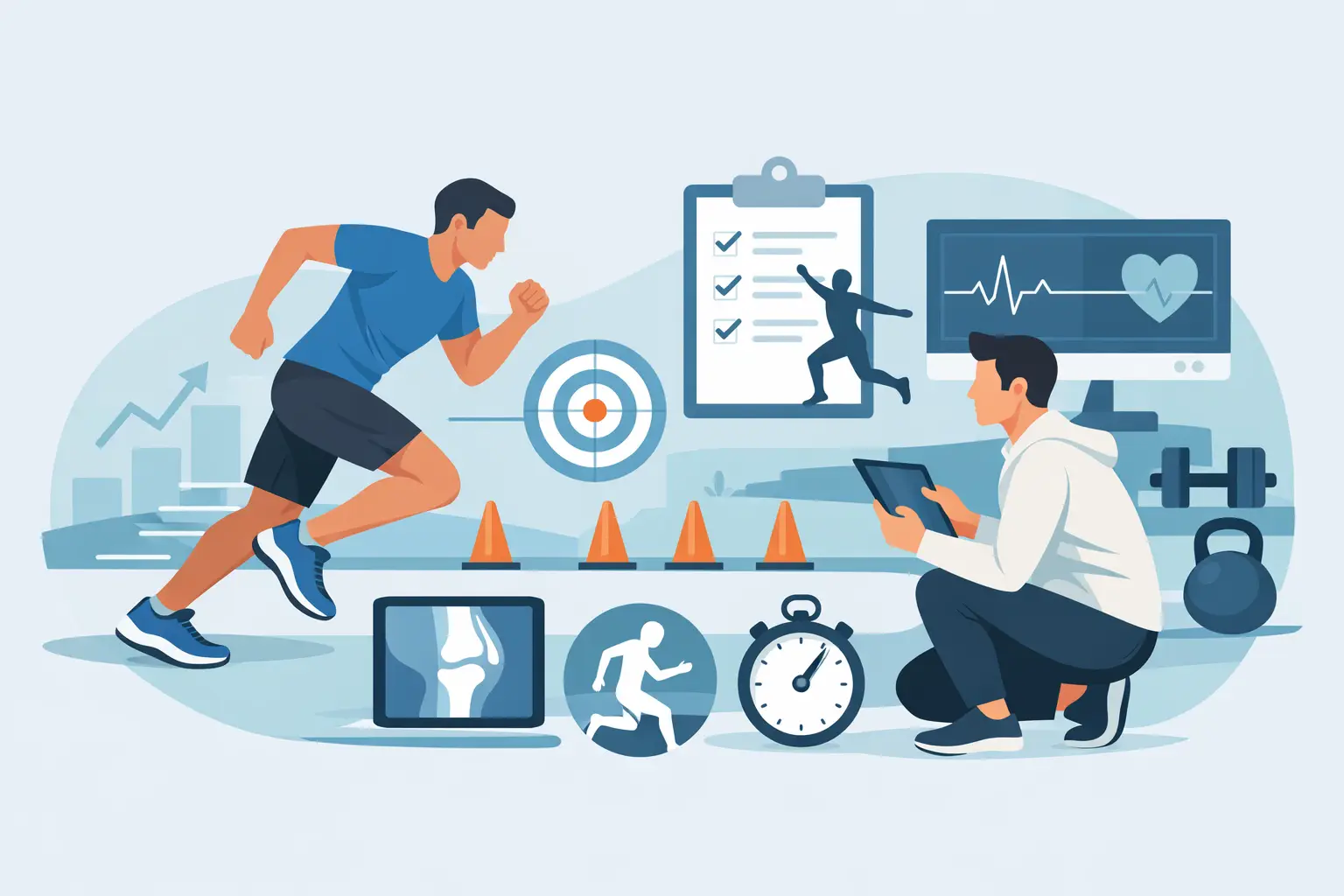
At its best, return to sport testing is not a single test or a box to tick. It is a structured process that looks at whether an athlete has rebuilt the physical qualities their sport demands. That usually includes strength, power, balance, control, movement quality, endurance, and the ability to tolerate repeated effort.
There is also a psychological layer. Many clients feel strong until they have to accelerate, decelerate, jump, or trust a previously injured limb at speed. Confidence matters because hesitation changes mechanics, and altered mechanics can shift load into the wrong places.
A high-end testing process asks a more useful question than, Are you pain-free? It asks, Can you perform at a level that matches the demands of your sport with acceptable risk?
Why symptom-based clearance falls short
Pain is only one signal. Swelling may be down, daily function may feel normal, and range of motion may be restored, yet there can still be major deficits in force production or landing strategy. That matters because many sport injuries happen in high-load, high-speed situations, not during ordinary daily movement.
This is where people get into trouble. They are cleared because they can move, but not because they are truly ready. A runner may tolerate easy mileage but break down when pace climbs. A skier may feel fine in the gym but lack the eccentric control needed for repeated turns. An athlete returning after ACL reconstruction may show acceptable symmetry in one task while still demonstrating poor trunk control or delayed force absorption.
The trade-off is clear. Return too early, and the risk of reinjury rises. Wait too long without purpose, and athletes lose momentum, conditioning, and trust. Testing helps find the middle ground with more clarity.
What a strong return to sport testing process includes
The best return to sport testing reflects both the injury and the sport. A generic battery can be useful, but it should not be the final word. A tennis player, a lifter, and a field athlete do not need the exact same profile.
Most testing begins with baseline physical measures. Strength testing often sits at the centre because force production is foundational. That may involve isolated strength work, limb symmetry comparisons, or more advanced force-based measures when available. But symmetry alone is not enough. If both sides are weak, symmetry can hide the real issue.
From there, testing often moves into dynamic tasks. Hop variations, deceleration drills, landing assessments, change-of-direction work, and repeated effort tests can reveal whether strength is usable under speed and fatigue. This is where movement quality becomes harder to fake.
Capacity matters too. Sport is rarely one perfect effort. It is repeated outputs under accumulating fatigue. If an athlete tests well in the first few minutes and unravels later, that tells an important story.
A complete process also includes subjective input. How does the athlete rate confidence? Are they avoiding certain patterns? Do they trust the injured side in unpredictable moments? Elite rehab respects both data and lived experience.
The difference between passing tests and being ready
This is where nuance matters. Passing a few benchmarks does not automatically mean full competition exposure is appropriate.
Readiness exists on a spectrum. An athlete may be ready for controlled training before contact training. They may be ready for modified practice before unrestricted minutes. They may be physically prepared but still need a staged build in exposure to speed, chaos, or workload.
That distinction is often missed. Too many people think in binary terms: either not ready or fully cleared. In reality, the strongest return-to-sport decisions are layered. They consider tissue healing, physical metrics, sport demands, training history, and timing within the season.
A premium testing model does not chase a dramatic clearance moment. It builds a progression that makes the next step obvious.
Common benchmarks used in return to sport testing
Different injuries call for different standards, but several categories show up consistently. Strength is one. For lower-body injuries, clinicians often want to see strong restoration in quadriceps, hamstrings, calf, and hip capacity, depending on the case. Power is another, particularly in sports that involve sprinting, jumping, or explosive changes of direction.
Single-leg control is especially important. Many injuries reveal themselves when the body has to absorb force on one side with precision. Hop tests, single-leg landing mechanics, and balance under movement can all expose deficits that bilateral exercises miss.
Reactive ability matters in field and court sports. Athletes do not move in straight lines on command alone. They respond, rotate, brake, and reposition. A testing process that ignores this can overestimate readiness.
Finally, there is workload tolerance. Can the athlete handle enough volume to survive training, not just complete one polished test session? This is often the dividing line between clinical success and actual return.
Why context changes the standard
Return to sport testing should never exist in a vacuum. The demands of the sport, the level of competition, and the athlete's training age all matter.
A recreational runner returning from Achilles pain may not need the same testing depth as a competitive soccer player coming back from ACL surgery. A golfer may need rotational power and tolerance more than maximal sprint exposure. A hockey player may require a very different progression than a CrossFit athlete, even if both are recovering from the same knee issue.
There is also the calendar. In-season return carries different pressures than off-season return. So does a first-time injury versus a repeat injury. Precision means adapting the standard without lowering it carelessly.
When should return to sport testing happen?
Not at the end only.
The most effective rehab plans use testing across the full arc of recovery. Early benchmarks help establish what needs to be rebuilt. Mid-stage testing shows whether progress is real or just feels better. End-stage testing supports decision-making when training intensity starts to rise.
This matters because late surprises are expensive. If major deficits are discovered only when an athlete expects to be cleared, timelines stretch and confidence drops. Regular checkpoints keep the process honest and focused.
In a performance-led setting, testing is not a final exam. It is part of the system.
What athletes should look for in a testing process
If the process feels rushed, overly generic, or based only on pain levels, that is a concern. Strong return to sport testing should feel specific, objective, and clearly tied to what you want to return to.
Athletes should understand why each test is being used, what standard they are being measured against, and what happens if a deficit appears. Data without interpretation has limited value. The goal is not simply to collect numbers. The goal is to use those numbers to direct the next phase of rehab and training.
That is where a performance clinic stands apart. At Orchard, the lens is not basic discharge. It is whether your body is prepared for the demands that matter to you, whether that is competitive sport, high-level training, or simply moving with the confidence and output you expect from yourself.
The case for a higher standard
For performance-driven clients, return is not enough. The real objective is returning well.
That means restoring capacity, not just settling symptoms. It means understanding whether your movement holds up under pressure. It means respecting the reality that sport exposes every shortcut in a rehab plan.
Return to sport testing gives that process structure. It creates a more honest picture of where you are, what still needs work, and how to move forward without relying on optimism alone.
If you are serious about getting back to your sport, your training, or your edge, the right question is not, Am I cleared? It is, Have I earned the level of performance I want to return to?