
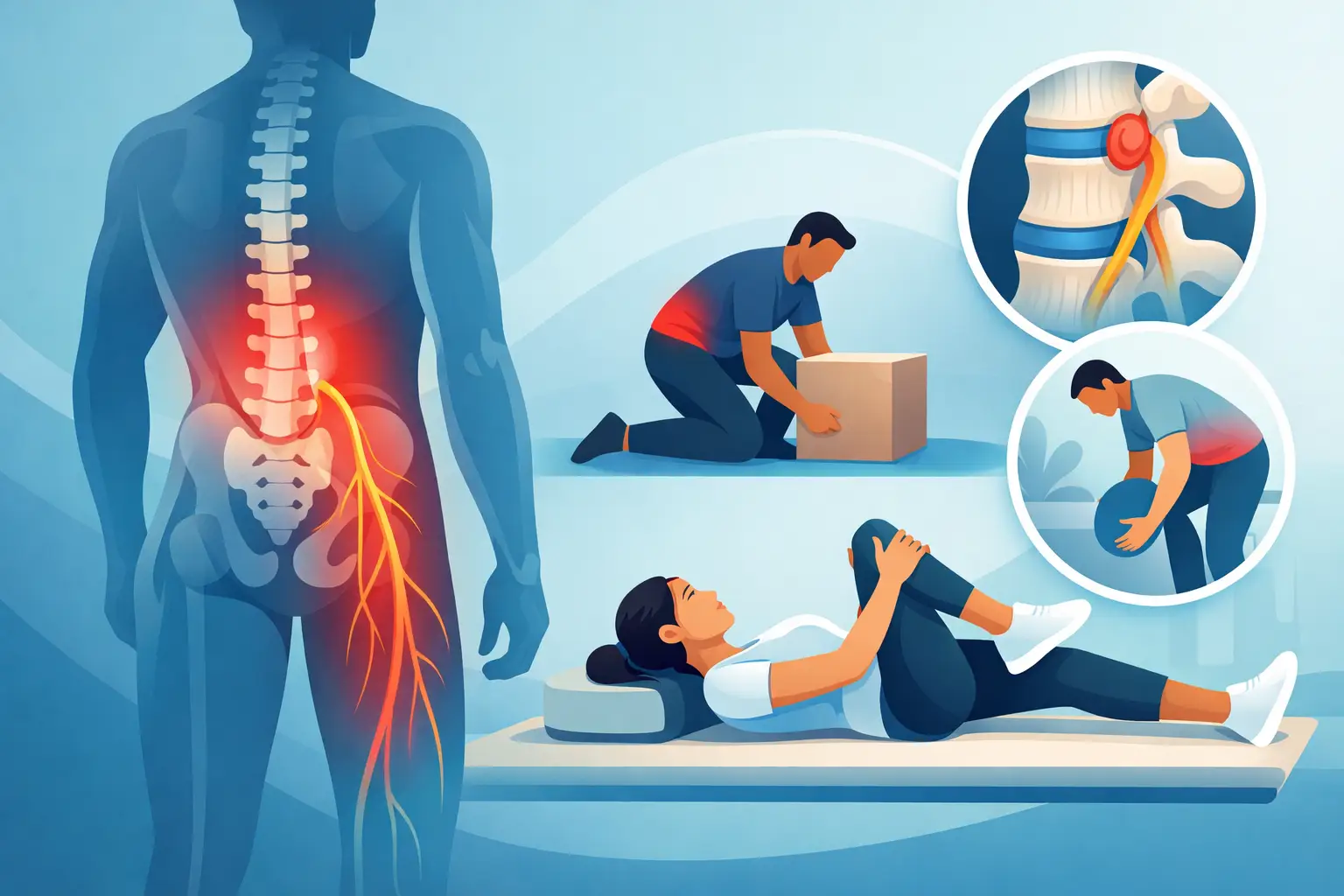
A familiar pattern brings many active people into the clinic: a sharp line of pain from the low back or glute into the leg, often appearing after a heavy lift, a long drive, or an ordinary movement that suddenly feels anything but ordinary. So, what is sciatica? It is a term for pain related to irritation or compression of the sciatic nerve roots, typically felt through one side of the lower body.
Sciatica can be disruptive, but it is not automatically a sign of serious damage or a permanent limitation. The right next step depends on the pattern of your symptoms, your neurological signs, your training demands, and how your body responds over time. Precision matters more than panic.
What Is Sciatica, Exactly?
The sciatic nerve is the largest nerve in the body. It is formed by nerve roots that leave the lower spine, travel through the pelvis and gluteal region, then continue down the back of each leg. When one or more of those nerve roots becomes irritated, pain may be felt anywhere along that pathway.
That is why sciatica is better understood as a symptom pattern than a standalone diagnosis. The source may be in the lumbar spine, although it can occasionally be influenced by structures around the hip or deep gluteal area. A high-quality assessment is designed to identify what is provoking the nerve and, just as importantly, what is not.
Sciatic pain is commonly one-sided. It may feel sharp, electric, burning, aching, or unusually sensitive. Some people notice pins and needles, numbness, or a sense that the leg is weaker or less reliable. For others, the dominant symptom is gluteal pain that intensifies with sitting, bending, coughing, or prolonged standing.
Why Sciatica Happens
A lumbar disc issue is one of the more common causes, particularly when symptoms begin after bending, lifting, or repeated spinal loading. Discs are the cushions between spinal bones. If disc material irritates a nearby nerve root, it can create pain that travels into the buttock, thigh, calf, or foot.
Other potential contributors include age-related changes that narrow the spaces around spinal nerves, joint irritation, or a condition called spondylolisthesis, where one vertebra shifts relative to another. In some cases, the nerve may be sensitized without a dramatic structural event. A long period of sitting, a rapid jump in training volume, reduced recovery, or an awkward movement can be enough to reveal an area that is already under load.
For performance-driven clients, context is essential. The same symptom can present very differently in a runner building mileage, a strength athlete returning to deadlifts, or an executive spending six hours in meetings before training. The question is not simply, “What structure hurts?” It is also, “What load can your system currently tolerate, and what needs to change for it to perform again?”
Sciatica Symptoms That Deserve Attention
Pain below the knee is often associated with sciatica, but it is not required. Symptoms can stay in the glute or thigh, especially early on. Sitting may be uncomfortable for one person, while walking or standing may be the greater trigger for another.
A physiotherapy assessment should look beyond pain intensity. It should consider sensation, muscle strength, reflexes, mobility, balance, walking mechanics, and the movements that reproduce or settle symptoms. This creates a more useful clinical picture than relying on a scan alone.
Seek urgent medical assessment if back or leg pain is accompanied by new trouble controlling bladder or bowel function, numbness around the groin or inner thighs, rapidly worsening weakness, fever, unexplained weight loss, significant trauma, or a history of cancer alongside new severe pain. These signs are uncommon, but they require prompt attention.
Progressive weakness also deserves timely assessment. Difficulty lifting the front of the foot, repeated tripping, or a noticeable loss of calf strength should not be treated as a problem to push through in the gym.
When Is Sciatica Not the Full Story?
Not every pain that travels down the leg is sciatica. Hip conditions, hamstring injuries, local gluteal pain, peripheral nerve irritation, and vascular concerns can create overlapping symptoms. This is one reason self-diagnosis can lead to the wrong recovery plan.
It is also worth separating nerve pain from ordinary muscular tightness. Tightness may be part of the experience, but aggressive stretching is not always the answer. If a nerve is irritable, repeatedly forcing a deep hamstring stretch can amplify symptoms rather than resolve them. The right dosage of movement is more valuable than the most intense stretch.
Imaging has a place when it will change medical decision-making, particularly when significant neurological symptoms are present or progress is not following an expected course. Yet findings on an MRI do not always match pain. Many people without symptoms have disc bulges and degenerative changes, which is why a scan must be interpreted alongside a thorough examination.
The First Phase: Reduce Irritability, Keep Moving
Complete bed rest is rarely the best strategy. In the early stage, the goal is to find tolerable movement and reduce the activities that sharply escalate symptoms. This might mean shorter walks, modified training, more frequent position changes during work, and temporarily reducing heavy spinal loading.
For some people, bending and sitting are the main aggravators. For others, standing upright or walking is more limited. The strategy should match the presentation. There is no universal “best exercise for sciatica,” and generic online routines can miss the mark when they are applied without assessment.
A clinician may use specific movement testing to understand whether symptoms centralize, meaning they retreat from the leg toward the back. This can be a useful sign that a chosen direction of movement is helping to settle the nerve. It is one data point, not a reason to force painful repetitions.
Pain relief can involve several options, including medication discussed with a physician or pharmacist, heat or cold based on preference, and targeted hands-on care where appropriate. These can make movement more accessible, but they are not the entire recovery plan. Lasting change usually comes from restoring capacity.
Build Capacity Before You Chase Intensity
Once symptoms are more settled, rehabilitation shifts from protection to progressive exposure. The aim is not to avoid every sensation forever. It is to rebuild confidence and strength without repeatedly exceeding the tissue and nervous system's current tolerance.
A considered programme may include trunk control, hip strength, single-leg stability, nerve mobility work when indicated, and a graded return to hinging, squatting, running, or sport-specific demands. The best plan respects your baseline. A cyclist needs a different return-to-performance strategy than a tennis player, and a recreational lifter may need different loading progressions than a competitive athlete.
Training does not always need to stop. Often, it needs to become more selective. Upper-body work, modified conditioning, or lower-body movements with a more tolerable range may allow you to maintain momentum while the irritated area settles. The trade-off is accepting a short-term adjustment to protect long-term progress.
Pain during rehabilitation is not automatically harmful, but it should be interpreted carefully. Mild, familiar symptoms that settle quickly may be acceptable within a structured plan. Pain that spreads farther down the leg, becomes more intense after each session, disturbs sleep, or leaves you worse the next day suggests the dosage needs adjustment.
Returning to Sport, Training and Daily Life
Recovery timelines vary. Some cases improve substantially within weeks, while others need a longer rebuilding phase, particularly when symptoms have been present for months or strength has been affected. The goal is not to wait for a mythical moment of perfect readiness. It is to demonstrate that you can tolerate progressively more of the movements and loads your life requires.
Before returning to maximal lifts, hard intervals, court sport, or long race efforts, assess the foundations: can you walk, sit, hinge, rotate, and train at lower intensities without a meaningful symptom flare? Is leg strength comparable enough for your activity? Can you recover between sessions? These benchmarks matter more than a single pain-free day.
At Orchard, the standard is not simply getting you comfortable enough to resume activity. It is restoring the movement quality, load tolerance, and confidence required to return with a more resilient physical foundation.
Sciatica can make the body feel unpredictable, especially when you are used to trusting it under pressure. Treat the symptom as useful information, not a verdict. With a clear assessment, intelligent load management, and progressive rehabilitation, most people can move from protecting the leg to trusting it again.